中文 | English
 新闻详情
新闻详情
新闻详情
新闻详情

万双网讯 月满鹏城,中秋意暖;实践启思,成长有声。中秋佳节到来之际,万科双语学校以PBL项目式学习为载体,结合PYP、MYP学段特点,分层设计一至九年级中秋主题实践作业,践行IB探究理念。同学们立足深圳,走出课堂,在观察、体验、调研与思辨中感悟传统节日的时代力量。
The full moon hangs over Pengcheng as the warmth of the Mid-Autumn Festival draws near; inquiry sparks practice, and growth takes voice. As the festival approached, Vanke Bilingual School (VBS) used Project-Based Learning as its mechanism for keeping with the characteristics of the PYP and MYP stages, designing tiered Mid-Autumn-themed practical assignments for Grades 1 through 9, putting IB’s inquiry philosophy into practice. Focusing in Shenzhen and on stepping out of the classroom, the students experienced the contemporary significance of this traditional festival through observation, firsthand experience, research, and critical thinking.
中秋是中国四大传统节日之一,象征着团圆与美好,寄托着中华民族对家庭和睦、家国安康的深厚情感。围绕这一节日,各年级依据学段特点确立了不同的探究主题:低学段侧重生活体验与自然观察,中学段侧重文化寻访与跨文化传播,高学段则侧重哲学思辨与公民品格塑造。各学段主题各有侧重,共同引领学生走近中秋文化,感悟城市生活,领悟成长的价值与意义。
The Mid-Autumn Festival is one of China’s four great traditional festivals, symbolizing reunion and happiness, and embodying the Chinese nation’s deep affection for family harmony and the well-being of family and country. For this festival, each grade set its own inquiry theme according to an appropriate stage of learning: the lower primary grades focused on everyday experiences and observations of nature; the upper primary grades on cultural exploration and cross-cultural communication; and the middle school grades on philosophical inquiry and the formation of civic character. Each stage had its own emphasis, yet together they guided students into Mid-Autumn culture, deepened their understanding of urban life, and helped them grasp the value and meaning of growth.
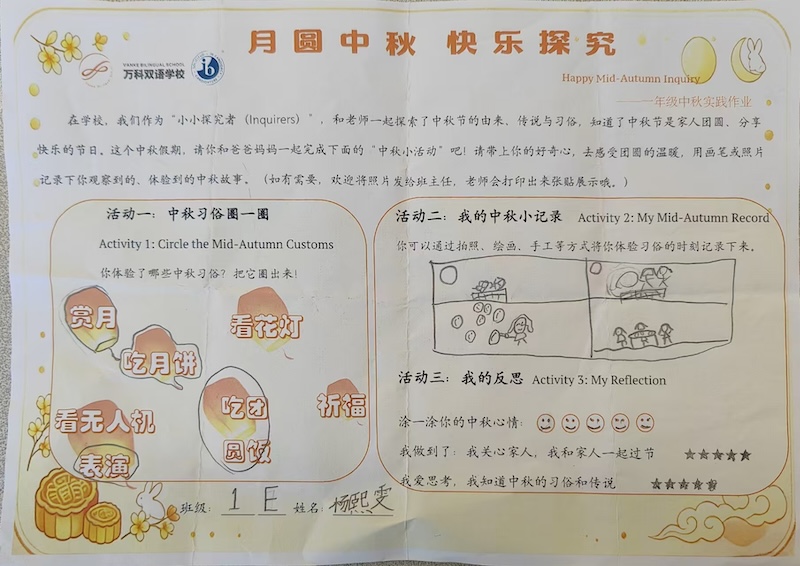
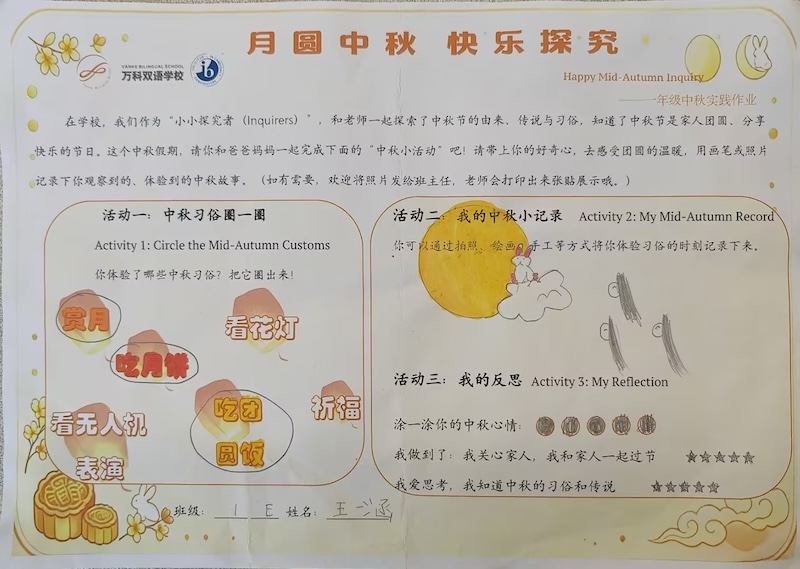
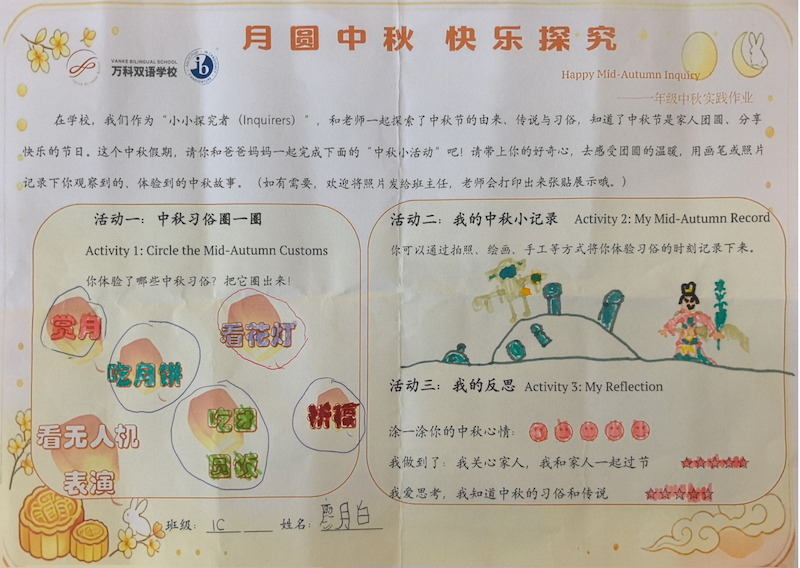
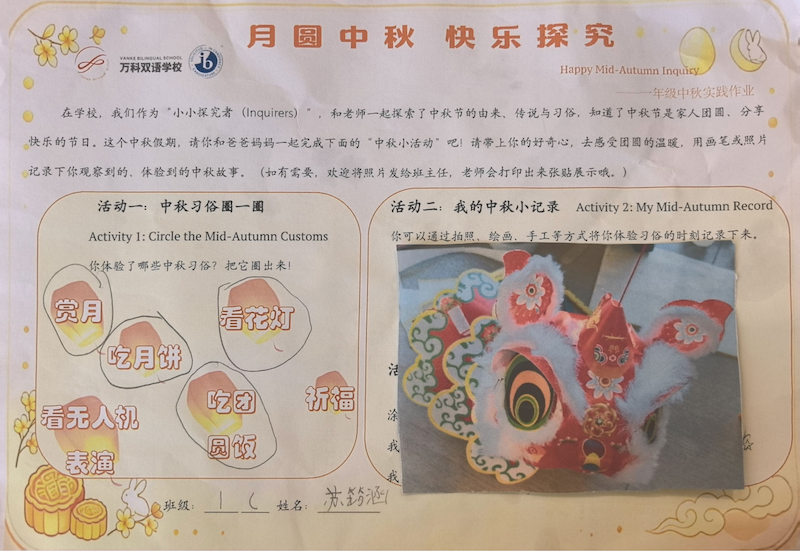
一年级的实践聚焦习俗体验,亲子共同认识赏月、吃月饼、看花灯等中秋民俗,让孩子在家庭互动、节日体验中了解中秋节的由来与传说,用绘画、照片等方式记录节日瞬间,在家人的温馨陪伴中萌发对“团圆”的感知。
Grade 1 focused on experiencing the festival’s customs: parents and children together explored Mid-Autumn traditions such as gazing at the full moon, eating mooncakes, and admiring festive lanterns. Through family interaction and festive experience, children learned the origins and legends of the festival, recorded its moments in drawings and photographs, and was surrounded by the warmth of their families while beginning to develop a sense of what “reunion” means.
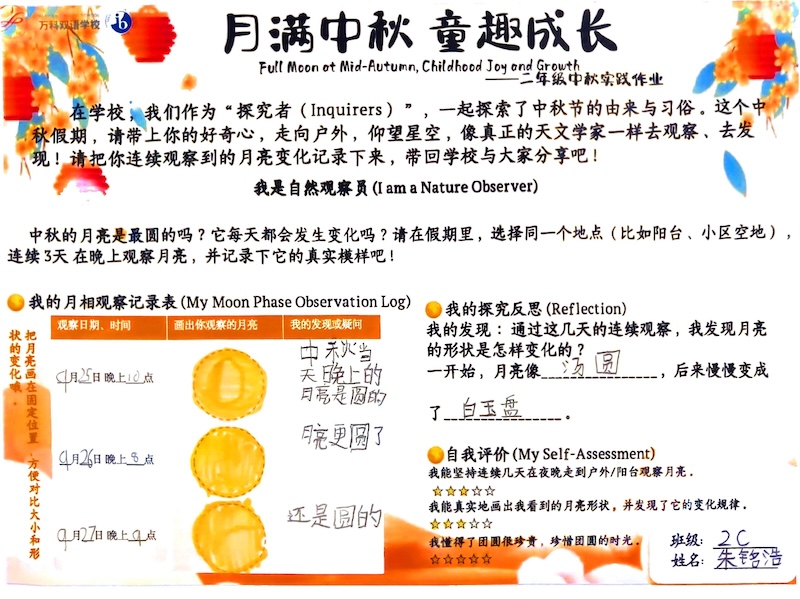
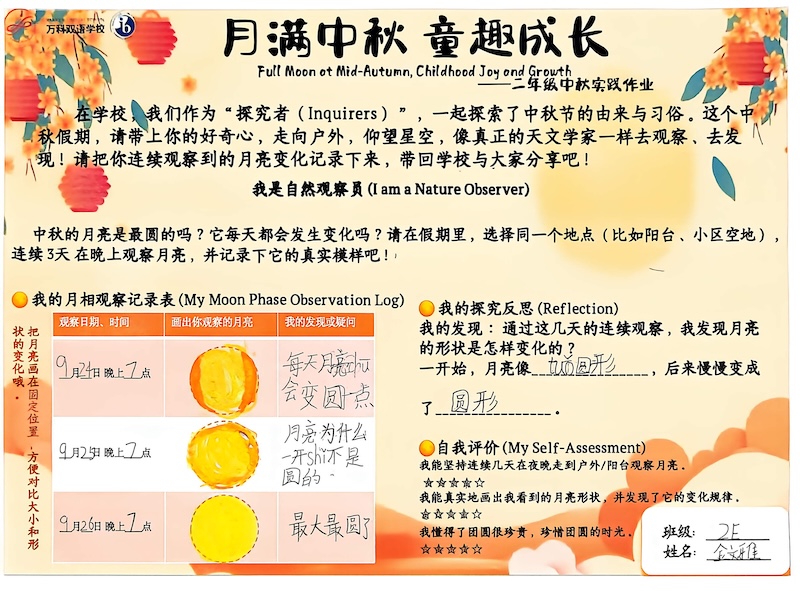
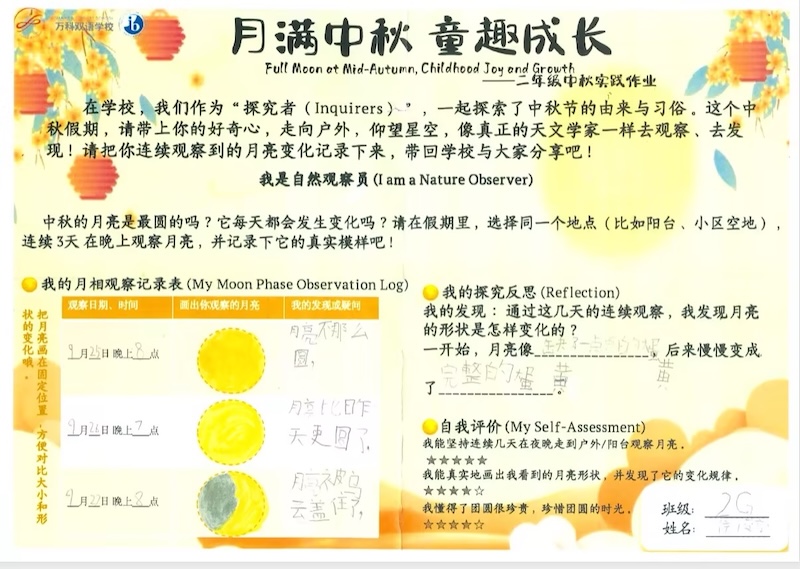
二年级融合自然科学,孩子们化身小小观察员,连续多晚观测并记录月相变化,用文字和图画呈现月相,在观察与思考中尝试发现月相变化规律,建立自然探究意识与科学记录的习惯。
Grade 2 integrated natural science as the children became little observers, tracking and recording the phases of the moon on successive nights and depicting them through words and drawings. Through observation and reflection, they sought to discover the patterns behind the changing moon phases, cultivating an awareness of natural inquiry and the habit of scientific record-keeping.
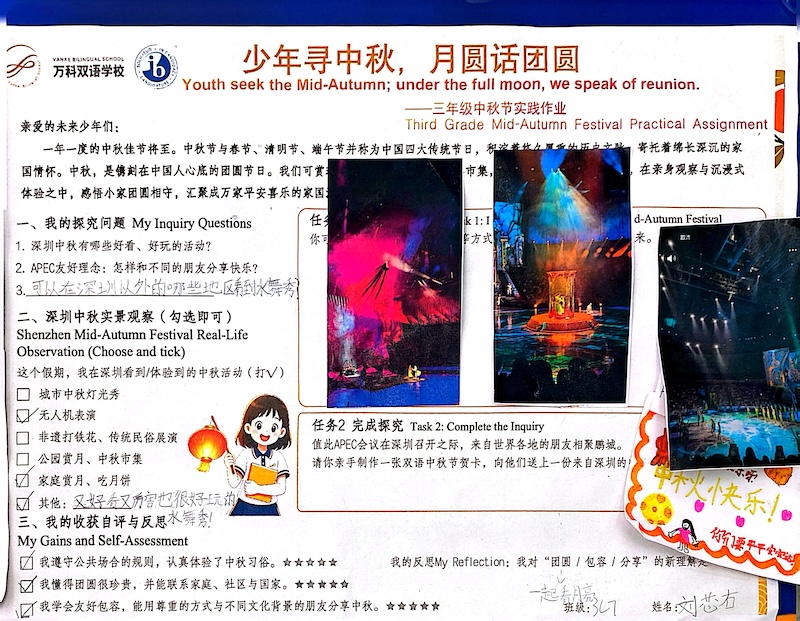
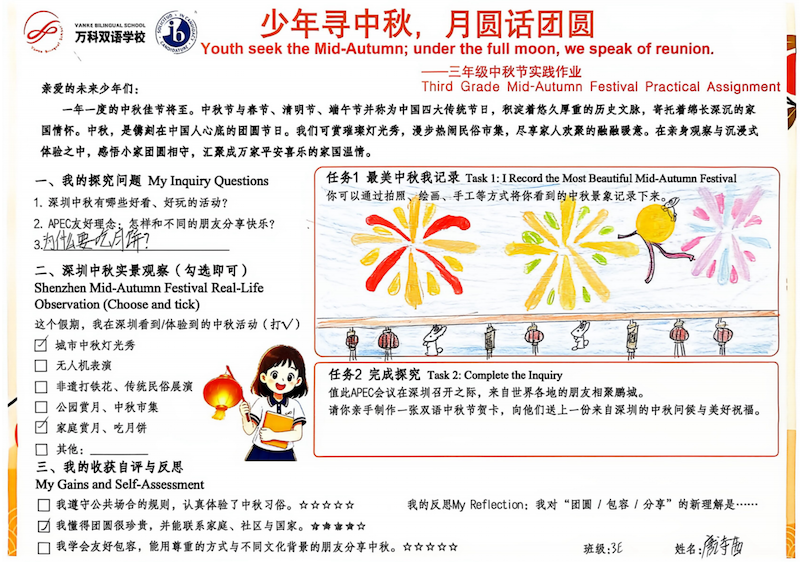
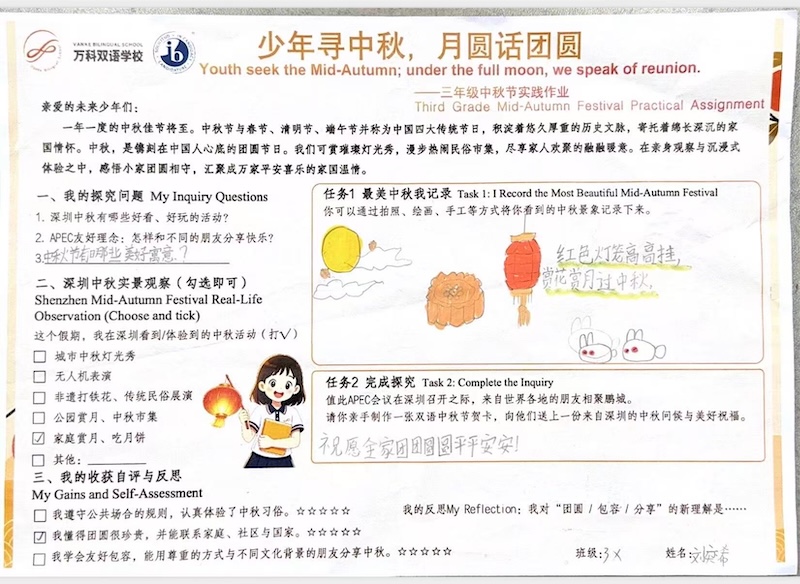
三年级结合APEC友好理念,探访深圳灯光秀、民俗市集等中秋实景,观察城市公共空间中的中秋元素。孩子们制作双语贺卡,向国际友人传递深圳的中秋祝福,培养跨文化理解与表达能力。
Grade 3 drew on the spirit of friendship embodied by APEC: the students visited real Mid-Autumn scenes across Shenzhen—such as the city’s light shows and folk-craft markets—and observed how the festival appeared in public urban spaces. They made bilingual greeting cards to convey Shenzhen’s Mid-Autumn wishes to international friends, developing their cross-cultural understanding and communication skills.
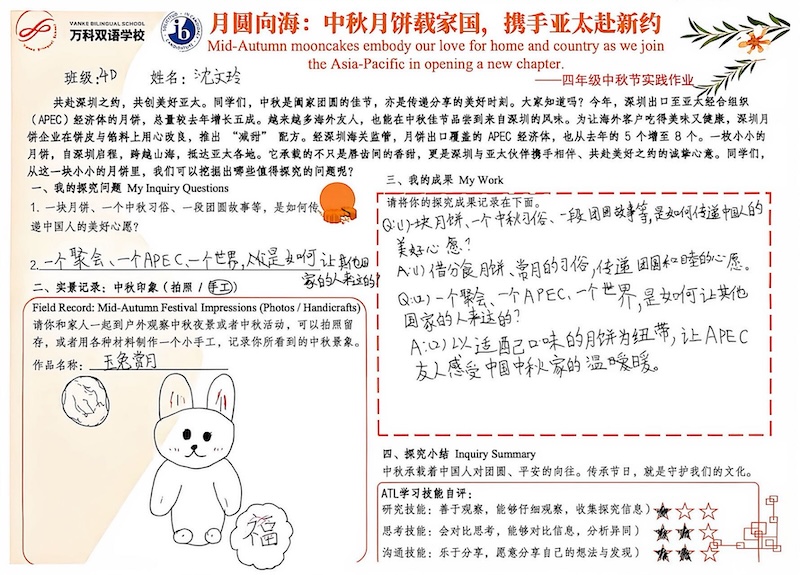
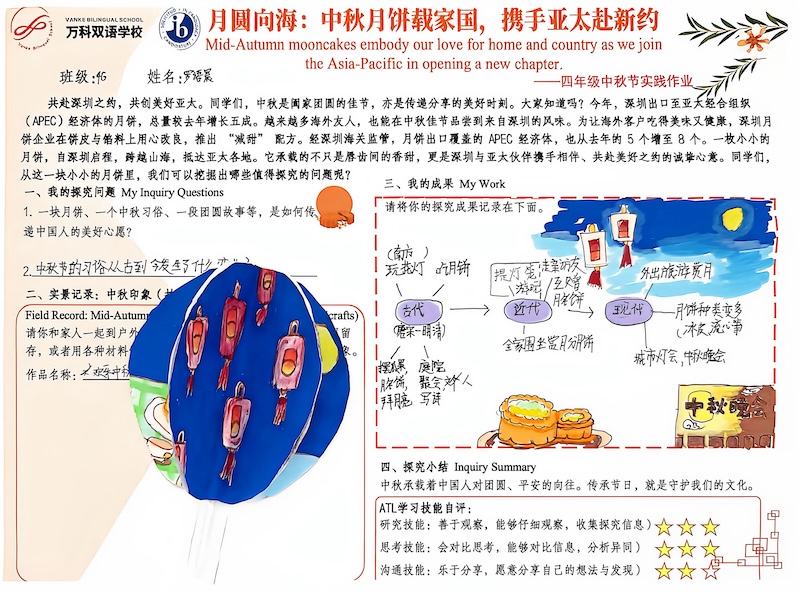
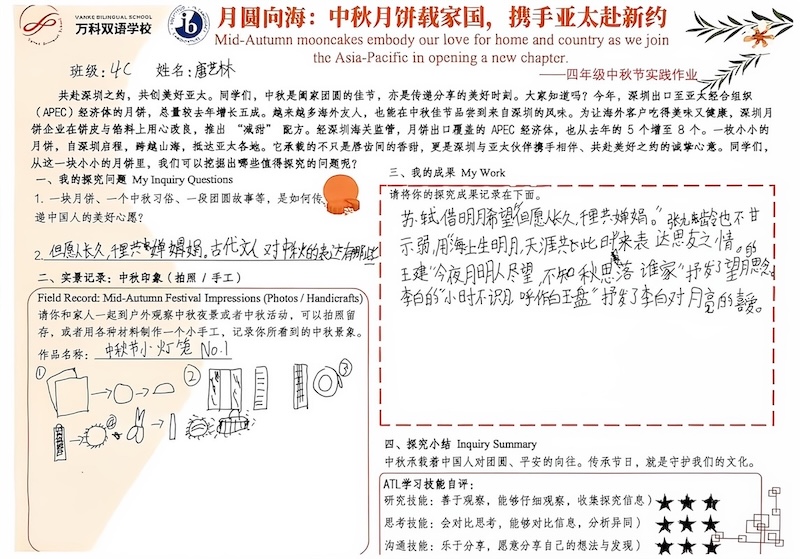
四年级以月饼为探究切口,结合深圳月饼出口亚太的真实案例,围绕月饼的起源、口味、文化寓意等展开探究,解读小小月饼承载的文化心意,感受中华传统文化走向世界的魅力。
Grade 4 took the mooncake as its focal point. Drawing on the real-world example of Shenzhen-exported mooncakes reaching out to the Asia-Pacific region, the students explored the origins, flavors, and cultural symbolism of the mooncake, unpacking the cultural sentiment carried within this small pastry and appreciating the appeal of traditional Chinese culture as it reaches the world.
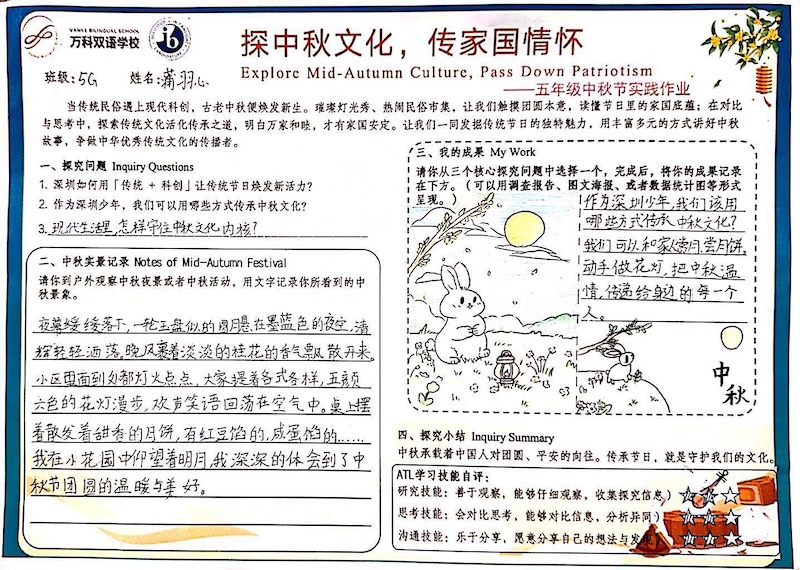
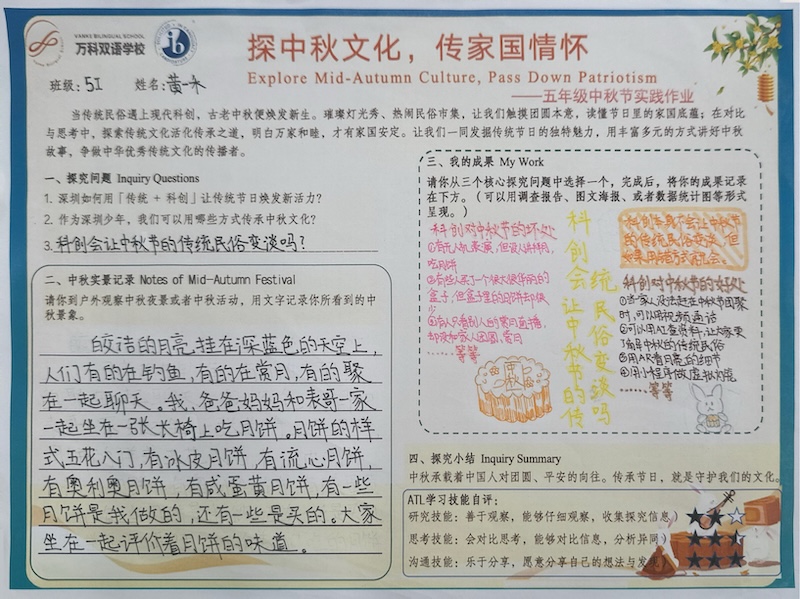
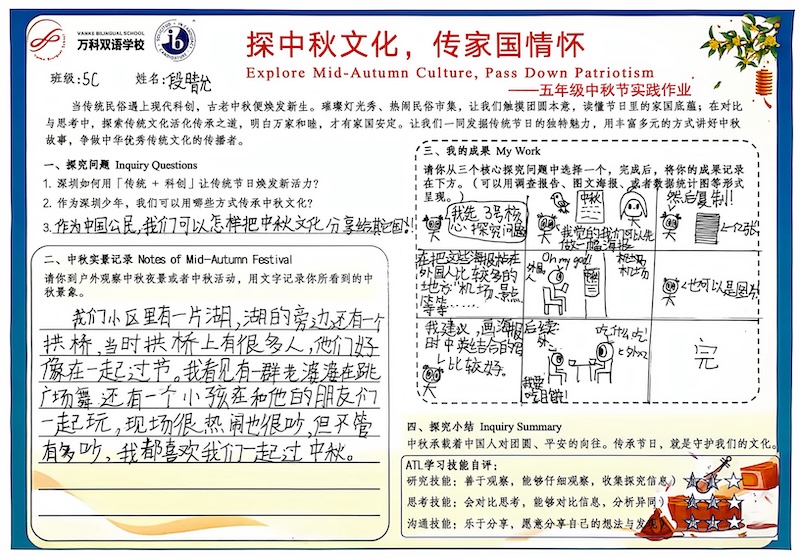
五年级围绕“传统+科创”,观察深圳科技赋能下的中秋新样貌,从城市光影、数字传播等角度思考传统习俗的创新表达,以海报、调查报告等形式呈现当代青少年传承传统文化的可行方式。
Grade 5 centered on “tradition + innovation.” The students observed how technology is reshaping the Mid-Autumn Festival in Shenzhen, through the city’s nightscapes and digital communication—how traditional customs might be expressed in new ways. They presented feasible approaches for the young people of today to carry forward traditional culture, through the use of posters and research reports.
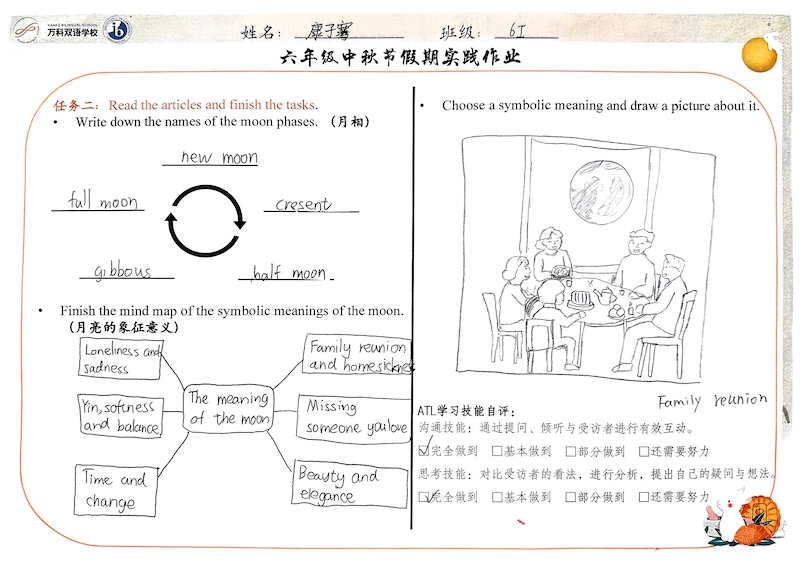
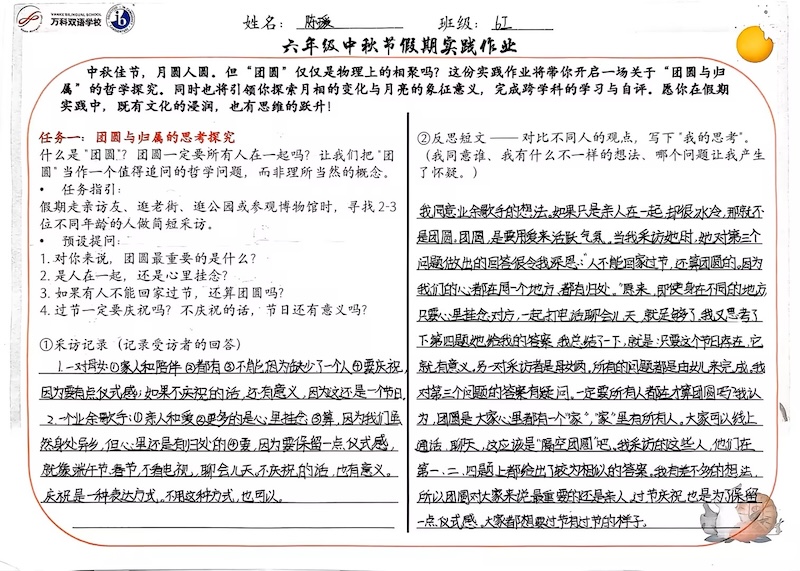
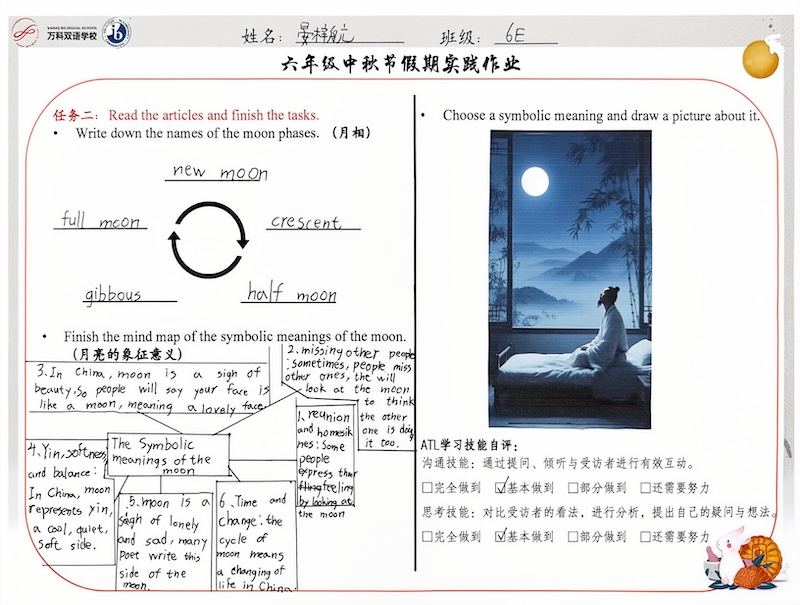
六年级展开“团圆与归属”的哲学思辨,学生们自主设计采访提纲走上街头,采访不同年龄段的人群,探讨团圆与归属的多元定义,并结合月相知识思考月亮的象征意义,提升采访调研与批判性思考能力。
Grade 6 undertook the philosophical inquiry of “reunion and belonging.” The students designed their own interview outlines, took to the streets, and interviewed people of different ages to explore the many meanings of reunion and belonging. Drawing on their knowledge of the moon’s phases, they also reflected on the symbolic meaning of the moon—honing their interviewing, research, and critical-thinking skills.
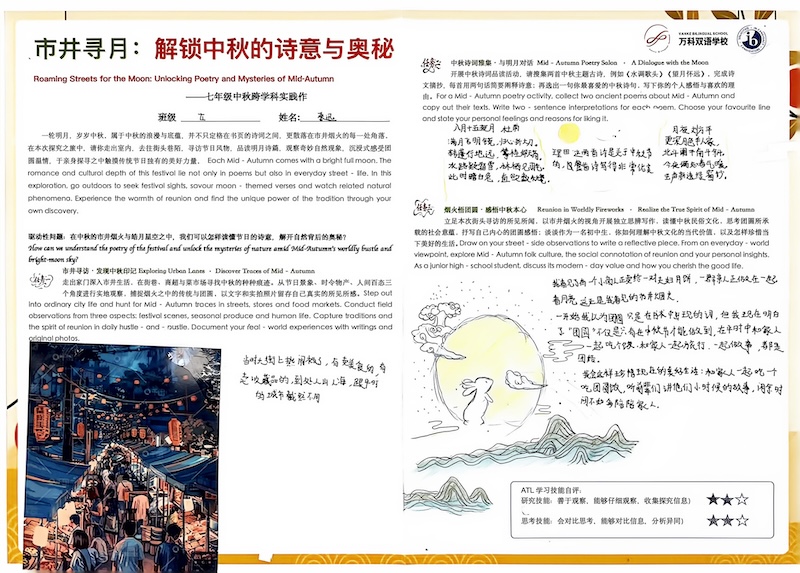
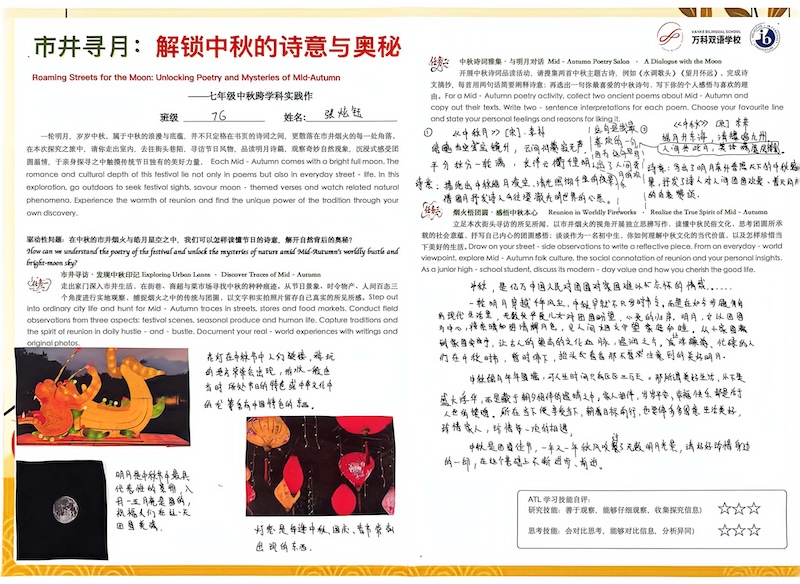
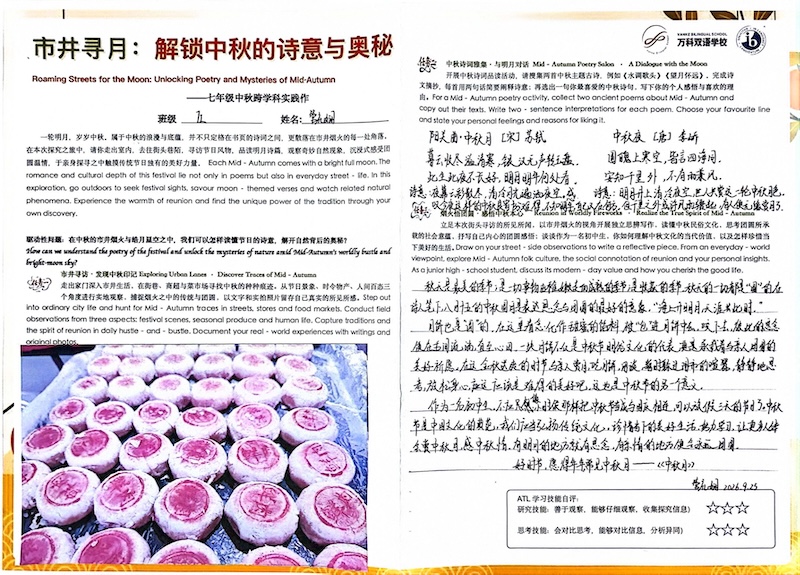
七年级走进市井街巷寻访中秋印记,同学们走进社区、街巷、市场等城市生活场景,寻访节日风物,品读中秋古诗词,结合实地见闻开展写作,感悟市井烟火里中秋的诗意与当代价值。
Grade 7 stepped into the city’s streets and alleyways in search of traces of the Mid-Autumn Festival. The students entered urban life—communities, lanes, and markets—to seek out the festival’s seasonal objects, read classical Mid-Autumn poetry, and write based on what they observed firsthand, sensing both the poetry and the contemporary value of the festival within the everyday life of the streets.
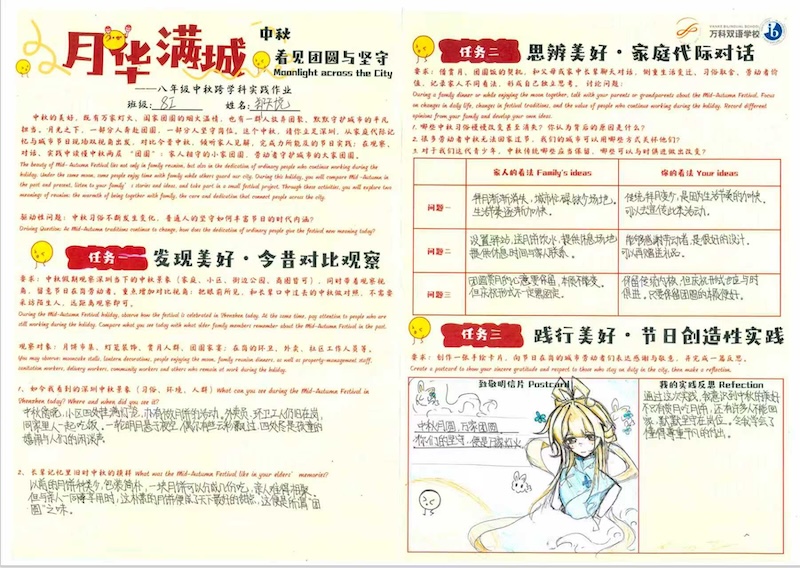
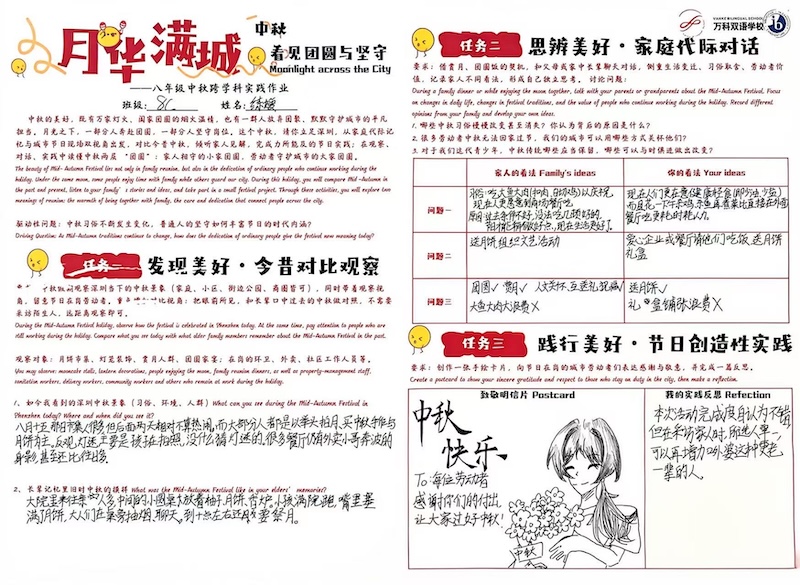
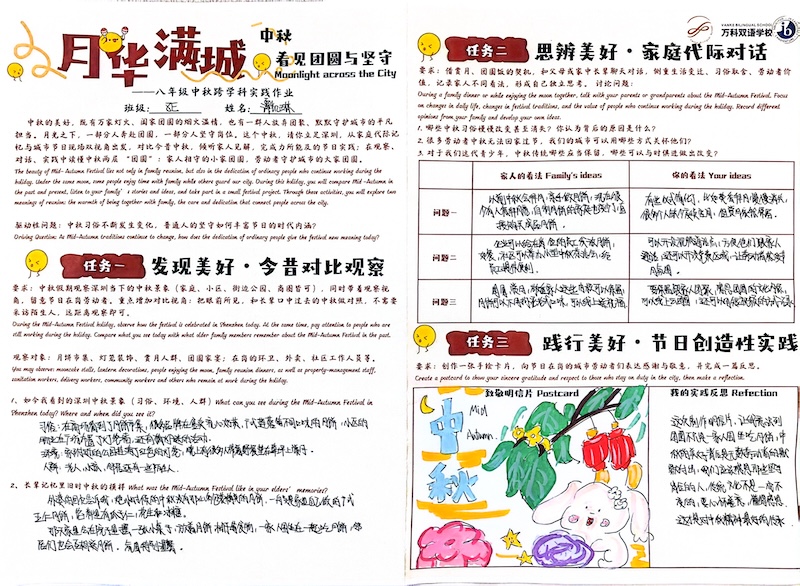
八年级围绕“团圆与坚守”,通过家庭代际对话对比中秋习俗变迁,了解不同年代中秋习俗的变化以及城市与时代的发展,关注节日坚守岗位的城市劳动者,以文字或手绘向劳动者表达敬意,理解团圆背后的坚守与付出。
Grade 8 centered on “reunion and dedication.” Through intergenerational conversations with their families, the students compared how Mid-Autumn customs have changed, understanding the festival across different eras and alongside the development of the city and the times. They turned their attention to the urban workers who remained on duty during the holiday, expressing their respect in words or hand-drawn pictures and coming to understand the dedication and sacrifice that lies behind reunion.
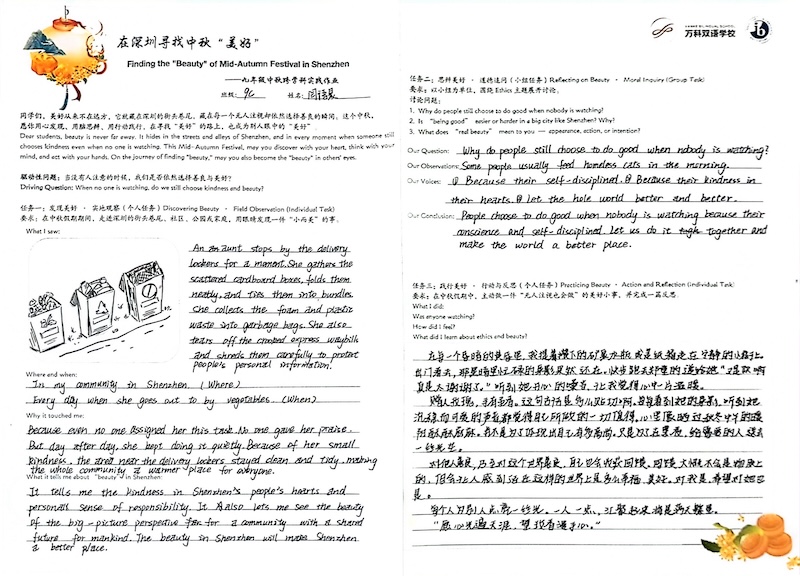
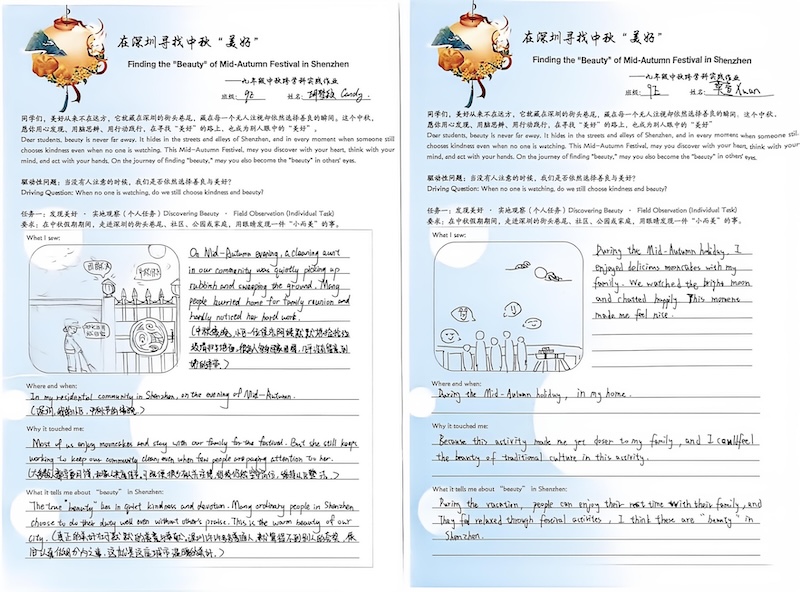
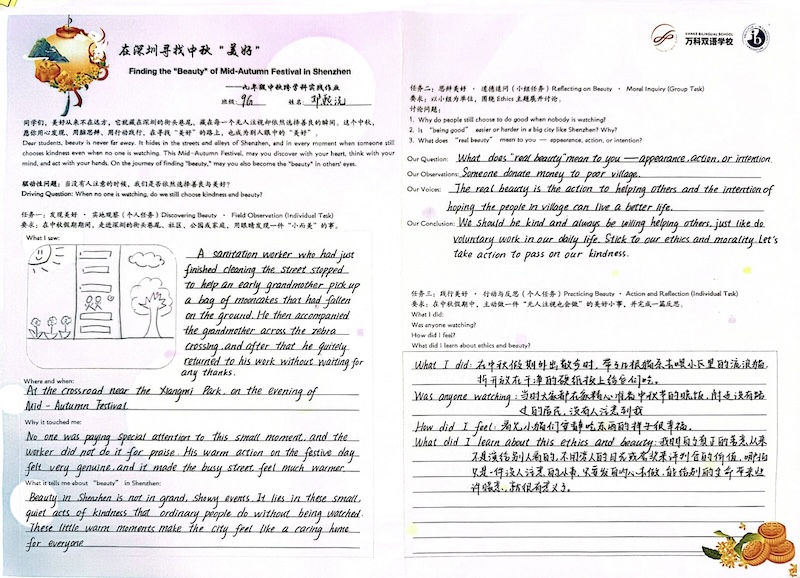
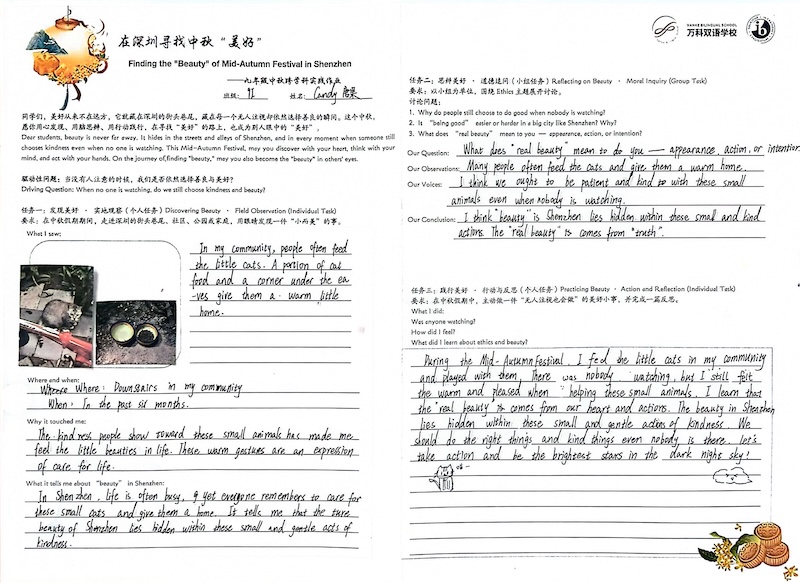
九年级立足MYP伦理探究,从“发现生活中的美好”出发,以“无人看见时,我们是否依然选择善良与美好”为驱动问题。同学们观察城市中的善意瞬间,开展小组伦理研讨,并亲身践行微小善举,在思辨与行动中理解无人注视时依然选择善良与美好的价值。
Grade 9 grounded itself in MYP ethical inquiry. Starting from “discovering the good in everyday life,” the class took as its driving question: “When no one is watching, do we still choose kindness and goodness?” The students observed moments of kindness in the city, held group ethical discussions, and made small acts of goodness themselves—coming to understand, through reflection and action, the value of choosing kindness even when unseen.
中秋不仅是传统意义上的佳节,更是一个融合文化、天文与生活探究的教育契机。万科双语学校将中秋转化为真实的PBL探究项目,将IB探究理念融入传统节日教育。同学们在真实情境中加深了对中秋文化的理解,提升了观察记录、调研采访、跨文化表达与伦理反思能力,同时在关注城市劳动者、践行微小善举的过程中体悟团圆、坚守与善意的价值。未来,学校将继续以真实问题为驱动,让传统文化在探究中焕发新的育人力量。
The Mid-Autumn Festival is more than just a time-honored holiday; it is an educational opportunity that brings together culture, astronomy, and inquiry into daily life. Vanke Bilingual School transformed the festival into a genuine PBL project, weaving the IB inquiry philosophy into the teaching of a traditional festival. In authentic contexts, the students deepened their understanding of Mid-Autumn culture and strengthened their abilities in observation and record-keeping, research, interviewing, cross-cultural expression, and ethical reflection. At the same time, by turning their attention to the city’s workers and practicing small acts of kindness, they came to appreciate the values of reunion, dedication, and goodwill. Looking ahead, the school will continue to be driven by real-world questions, allowing traditional culture to take on fresh educational vitality through inquiry.
资料提供:彭平
翻译:詹晰惠
翻译校对:Timothy Beers
初审:王子玮
复审:陈诺斯
终审:周金凤
排版:马葳
万双网讯 月满鹏城,中秋意暖;实践启思,成长有声。中秋佳节到来之际,万科双语学校以PBL项目式学习为载体,结合PYP、MYP学段特点,分层设计一至九年级中秋主题实践作业,践行IB探究理念。同学们立足深圳,走出课堂,在观察、体验、调研与思辨中感悟传统节日的时代力量。
The full moon hangs over Pengcheng as the warmth of the Mid-Autumn Festival draws near; inquiry sparks practice, and growth takes voice. As the festival approached, Vanke Bilingual School (VBS) used Project-Based Learning as its mechanism for keeping with the characteristics of the PYP and MYP stages, designing tiered Mid-Autumn-themed practical assignments for Grades 1 through 9, putting IB’s inquiry philosophy into practice. Focusing in Shenzhen and on stepping out of the classroom, the students experienced the contemporary significance of this traditional festival through observation, firsthand experience, research, and critical thinking.
中秋是中国四大传统节日之一,象征着团圆与美好,寄托着中华民族对家庭和睦、家国安康的深厚情感。围绕这一节日,各年级依据学段特点确立了不同的探究主题:低学段侧重生活体验与自然观察,中学段侧重文化寻访与跨文化传播,高学段则侧重哲学思辨与公民品格塑造。各学段主题各有侧重,共同引领学生走近中秋文化,感悟城市生活,领悟成长的价值与意义。
The Mid-Autumn Festival is one of China’s four great traditional festivals, symbolizing reunion and happiness, and embodying the Chinese nation’s deep affection for family harmony and the well-being of family and country. For this festival, each grade set its own inquiry theme according to an appropriate stage of learning: the lower primary grades focused on everyday experiences and observations of nature; the upper primary grades on cultural exploration and cross-cultural communication; and the middle school grades on philosophical inquiry and the formation of civic character. Each stage had its own emphasis, yet together they guided students into Mid-Autumn culture, deepened their understanding of urban life, and helped them grasp the value and meaning of growth.
一年级的实践聚焦习俗体验,亲子共同认识赏月、吃月饼、看花灯等中秋民俗,让孩子在家庭互动、节日体验中了解中秋节的由来与传说,用绘画、照片等方式记录节日瞬间,在家人的温馨陪伴中萌发对“团圆”的感知。
Grade 1 focused on experiencing the festival’s customs: parents and children together explored Mid-Autumn traditions such as gazing at the full moon, eating mooncakes, and admiring festive lanterns. Through family interaction and festive experience, children learned the origins and legends of the festival, recorded its moments in drawings and photographs, and was surrounded by the warmth of their families while beginning to develop a sense of what “reunion” means.
二年级融合自然科学,孩子们化身小小观察员,连续多晚观测并记录月相变化,用文字和图画呈现月相,在观察与思考中尝试发现月相变化规律,建立自然探究意识与科学记录的习惯。
Grade 2 integrated natural science as the children became little observers, tracking and recording the phases of the moon on successive nights and depicting them through words and drawings. Through observation and reflection, they sought to discover the patterns behind the changing moon phases, cultivating an awareness of natural inquiry and the habit of scientific record-keeping.
三年级结合APEC友好理念,探访深圳灯光秀、民俗市集等中秋实景,观察城市公共空间中的中秋元素。孩子们制作双语贺卡,向国际友人传递深圳的中秋祝福,培养跨文化理解与表达能力。
Grade 3 drew on the spirit of friendship embodied by APEC: the students visited real Mid-Autumn scenes across Shenzhen—such as the city’s light shows and folk-craft markets—and observed how the festival appeared in public urban spaces. They made bilingual greeting cards to convey Shenzhen’s Mid-Autumn wishes to international friends, developing their cross-cultural understanding and communication skills.
四年级以月饼为探究切口,结合深圳月饼出口亚太的真实案例,围绕月饼的起源、口味、文化寓意等展开探究,解读小小月饼承载的文化心意,感受中华传统文化走向世界的魅力。
Grade 4 took the mooncake as its focal point. Drawing on the real-world example of Shenzhen-exported mooncakes reaching out to the Asia-Pacific region, the students explored the origins, flavors, and cultural symbolism of the mooncake, unpacking the cultural sentiment carried within this small pastry and appreciating the appeal of traditional Chinese culture as it reaches the world.
五年级围绕“传统+科创”,观察深圳科技赋能下的中秋新样貌,从城市光影、数字传播等角度思考传统习俗的创新表达,以海报、调查报告等形式呈现当代青少年传承传统文化的可行方式。
Grade 5 centered on “tradition + innovation.” The students observed how technology is reshaping the Mid-Autumn Festival in Shenzhen, through the city’s nightscapes and digital communication—how traditional customs might be expressed in new ways. They presented feasible approaches for the young people of today to carry forward traditional culture, through the use of posters and research reports.
六年级展开“团圆与归属”的哲学思辨,学生们自主设计采访提纲走上街头,采访不同年龄段的人群,探讨团圆与归属的多元定义,并结合月相知识思考月亮的象征意义,提升采访调研与批判性思考能力。
Grade 6 undertook the philosophical inquiry of “reunion and belonging.” The students designed their own interview outlines, took to the streets, and interviewed people of different ages to explore the many meanings of reunion and belonging. Drawing on their knowledge of the moon’s phases, they also reflected on the symbolic meaning of the moon—honing their interviewing, research, and critical-thinking skills.
七年级走进市井街巷寻访中秋印记,同学们走进社区、街巷、市场等城市生活场景,寻访节日风物,品读中秋古诗词,结合实地见闻开展写作,感悟市井烟火里中秋的诗意与当代价值。
Grade 7 stepped into the city’s streets and alleyways in search of traces of the Mid-Autumn Festival. The students entered urban life—communities, lanes, and markets—to seek out the festival’s seasonal objects, read classical Mid-Autumn poetry, and write based on what they observed firsthand, sensing both the poetry and the contemporary value of the festival within the everyday life of the streets.
八年级围绕“团圆与坚守”,通过家庭代际对话对比中秋习俗变迁,了解不同年代中秋习俗的变化以及城市与时代的发展,关注节日坚守岗位的城市劳动者,以文字或手绘向劳动者表达敬意,理解团圆背后的坚守与付出。
Grade 8 centered on “reunion and dedication.” Through intergenerational conversations with their families, the students compared how Mid-Autumn customs have changed, understanding the festival across different eras and alongside the development of the city and the times. They turned their attention to the urban workers who remained on duty during the holiday, expressing their respect in words or hand-drawn pictures and coming to understand the dedication and sacrifice that lies behind reunion.
九年级立足MYP伦理探究,从“发现生活中的美好”出发,以“无人看见时,我们是否依然选择善良与美好”为驱动问题。同学们观察城市中的善意瞬间,开展小组伦理研讨,并亲身践行微小善举,在思辨与行动中理解无人注视时依然选择善良与美好的价值。
Grade 9 grounded itself in MYP ethical inquiry. Starting from “discovering the good in everyday life,” the class took as its driving question: “When no one is watching, do we still choose kindness and goodness?” The students observed moments of kindness in the city, held group ethical discussions, and made small acts of goodness themselves—coming to understand, through reflection and action, the value of choosing kindness even when unseen.
中秋不仅是传统意义上的佳节,更是一个融合文化、天文与生活探究的教育契机。万科双语学校将中秋转化为真实的PBL探究项目,将IB探究理念融入传统节日教育。同学们在真实情境中加深了对中秋文化的理解,提升了观察记录、调研采访、跨文化表达与伦理反思能力,同时在关注城市劳动者、践行微小善举的过程中体悟团圆、坚守与善意的价值。未来,学校将继续以真实问题为驱动,让传统文化在探究中焕发新的育人力量。
The Mid-Autumn Festival is more than just a time-honored holiday; it is an educational opportunity that brings together culture, astronomy, and inquiry into daily life. Vanke Bilingual School transformed the festival into a genuine PBL project, weaving the IB inquiry philosophy into the teaching of a traditional festival. In authentic contexts, the students deepened their understanding of Mid-Autumn culture and strengthened their abilities in observation and record-keeping, research, interviewing, cross-cultural expression, and ethical reflection. At the same time, by turning their attention to the city’s workers and practicing small acts of kindness, they came to appreciate the values of reunion, dedication, and goodwill. Looking ahead, the school will continue to be driven by real-world questions, allowing traditional culture to take on fresh educational vitality through inquiry.
资料提供:彭平
翻译:詹晰惠
翻译校对:Timothy Beers
初审:王子玮
复审:陈诺斯
终审:周金凤
排版:马葳

让孩子站在未来中央
地址:深圳市龙华区民治街道华南路80号
Tel:0755-66866333
Email:p-vbs@msedu.email

办学理念:让孩子站在未来中央
培养(成长)目标:培养(成为)身体健康、人格健全、学力卓越,具有家国情怀和国际视野, 敢于创造美好未来的中国公民,为开创更美好、更和平的世界贡献力量。 地址:深圳市龙华区民治街道华南路80号 电话:0755-66866333 http://vbs.vanke.com Vanke Bilingual School, Longhua District, Shenzhen Educational Idea: Let our children experience the future. Training objectives: Our students will become citizens of China with good physical health, sound personality, excellent academic abilities, patriotism, international vision and the courage to create a better future and a more peaceful world. Address: No.80 Huanan Road, Minzhi Sub-district, Longhua District, Shenzhen Contact: 0755-66866333 http://vbs.vanke.com
学校网站二维码
QR code of school website
学校公众号二维码
QR code of school official account
