中文 | English
 新闻详情
新闻详情
新闻详情
新闻详情

万双网讯 端午,不只是一枚粽子的清香、一束艾草的芬芳,更是一场跨越两千余年的文化对话。今年端午,万科双语学校为一至八年级学生精心设计了分层递进、各具特色的实践作业体系——从“亲历感知”到“解码理解”,再到“思辨创新”,力求让每一位学生都能在适切的认知梯度上,触摸传统、审视当下、构想未来,真正实现“探究”“行动”“反思”三位一体的深度学习。
The Dragon Boat Festival is more than the fragrance of zongzi or the freshness of mugwort—it is a cultural dialogue spanning over two thousand years. This year, Vanke Bilingual School designed a practical assignment system for students from Grade 1 to Grade 8—guiding them with firsthand experience to decode and understand to enhance critical thinking and innovation. The goal was to enable every student, to touch tradition, examine the present, and envision the future; achieving deep learning associated with inquiry, action, and reflection.
在指尖与粽叶间,种下文化的“第一粒种子”
Planting the First Seeds of Culture Between Fingertips and Zongzi Leaves
一年级:亲子共融,感官启航
Grade 1: Family Engagement, Sensory Awakening
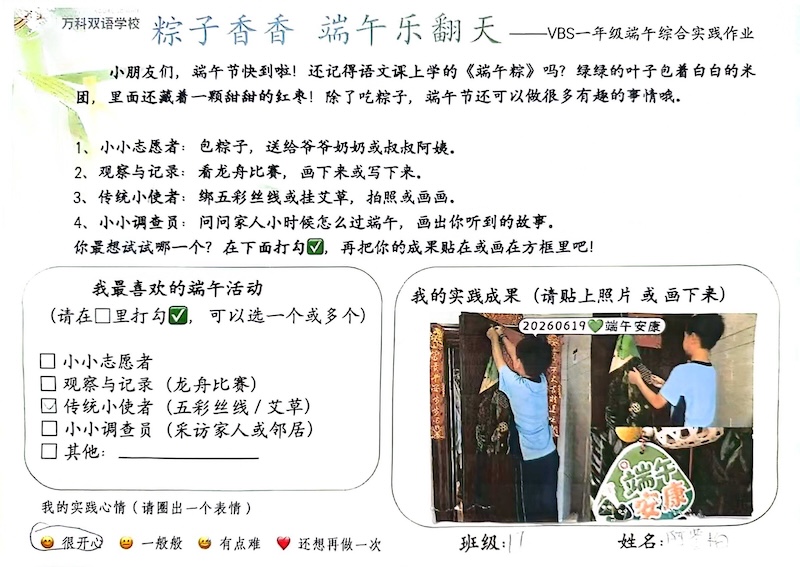
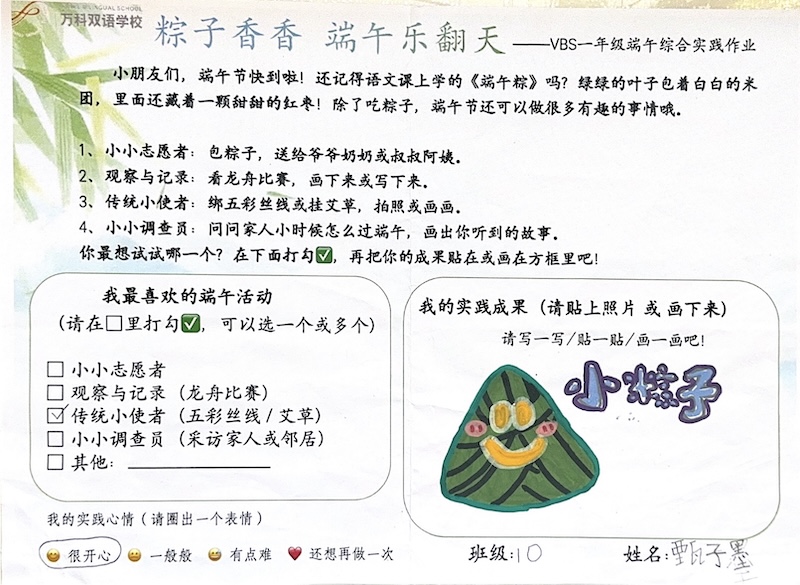
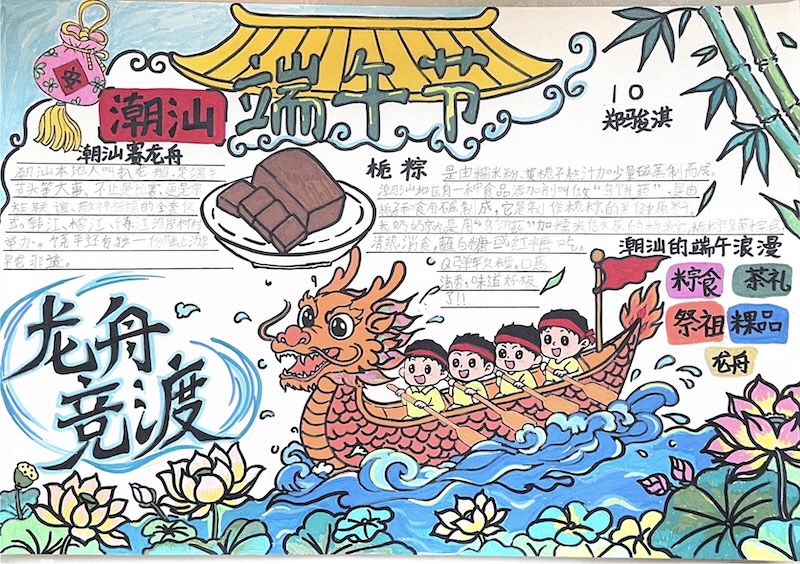
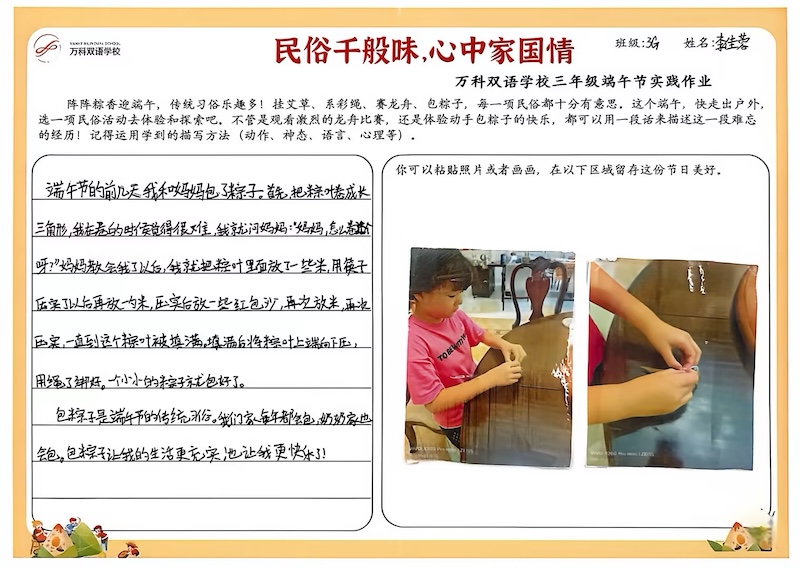
一年级的实践以“家庭”为场域、以“陪伴”为纽带。孩子们通过包粽子赠长辈、观龙舟竞渡、系五彩丝线,在河畔呐喊助威间感受力与美的激荡,腕间缠绕的缕缕彩线,则化作节日最灵动的视觉印记。最终,孩子们用相机定格笑脸、用画笔涂鸦记忆,让端午不再只是日历上的标注,而是可感、可触、可爱的童年片段。
The Grade 1 practice takes family and companionship as its setting and bond. Children make zongzi for their elders, watch dragon boat races, and tie colorful silk threads. Amidst the cheers along the riverside, they feel the interplay of power and beauty; the colorful threads wrapped around their wrists become the most vivid visual imprint of the festival. In the end, they freeze smiles with cameras and record memories with paintbrushes, transforming the Dragon Boat Festival from a date on the calendar into a tangible, touchable, and endearing fragment of childhood.
二年级:行走民俗,穿越对话
Grade 2: Experiencing Folk Customs on Foot and Time-Travel Dialogue
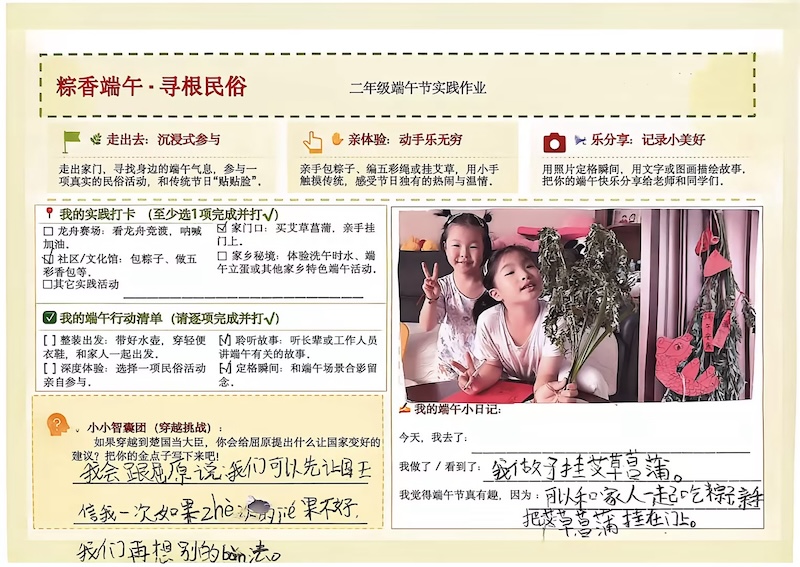
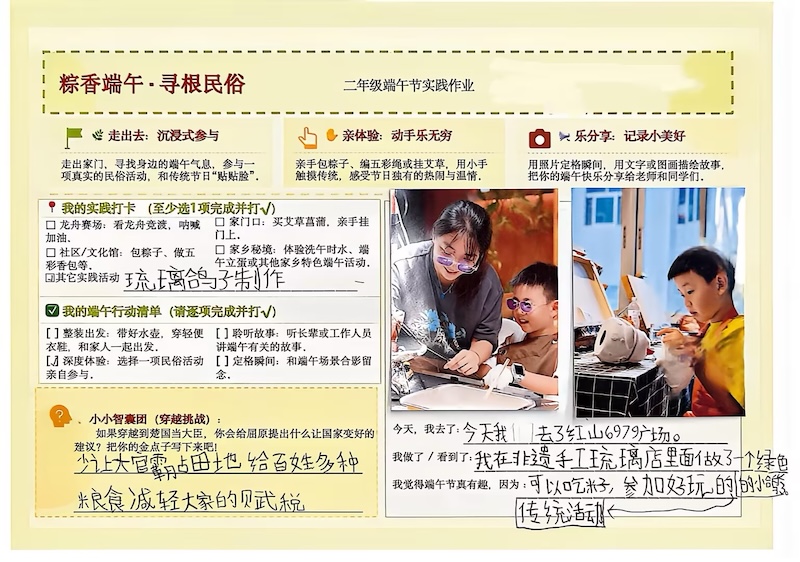
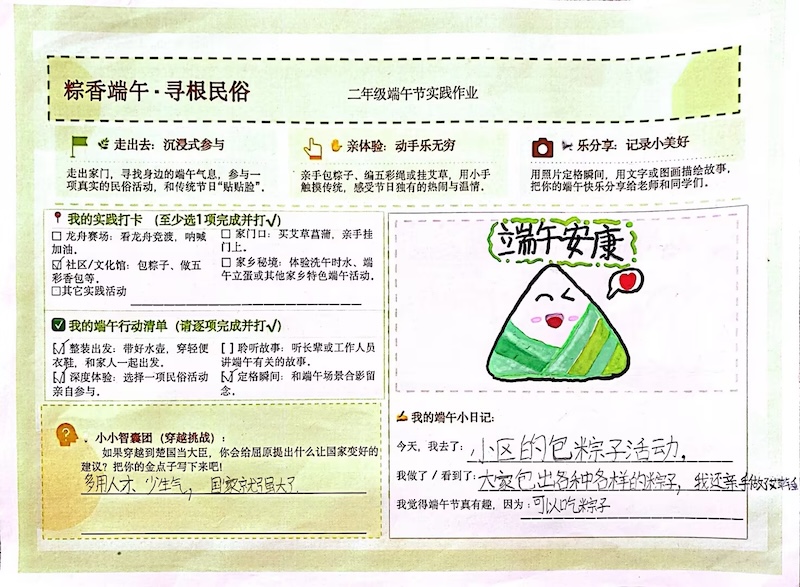
二年级学生走出家门,深度参与到真实民俗中去——包粽子的米香、编彩绳的指尖巧思,皆成为真实的感官教材。而“穿越挑战”任务则别具匠心:假如你穿越回战国,会向屈原提出怎样的治国建议?孩子们在童言稚语中融合历史感知与现代公民意识,让古老人物与当下思维碰撞出奇妙的火花。
Grade 2 students stepped out of their homes and immersed themselves in authentic folk customs—the aroma of sticky rice in zongzi-making and the dexterity of braiding colorful ropes became sensory lessons. The "Time-Travel Challenge" task was particularly ingenious: if you traveled back to the Warring States period, what advice would you offer Qu Yuan? Through innocent yet insightful words, children blended historical perceptions with modern civic awareness, sparking a wonderful collision between ancient figures and contemporary thinking.
三年级:溯源解码,从“做什么”到“为什么”
Grade 3: Tracing Origins and Decoding—from "What" to "Why"
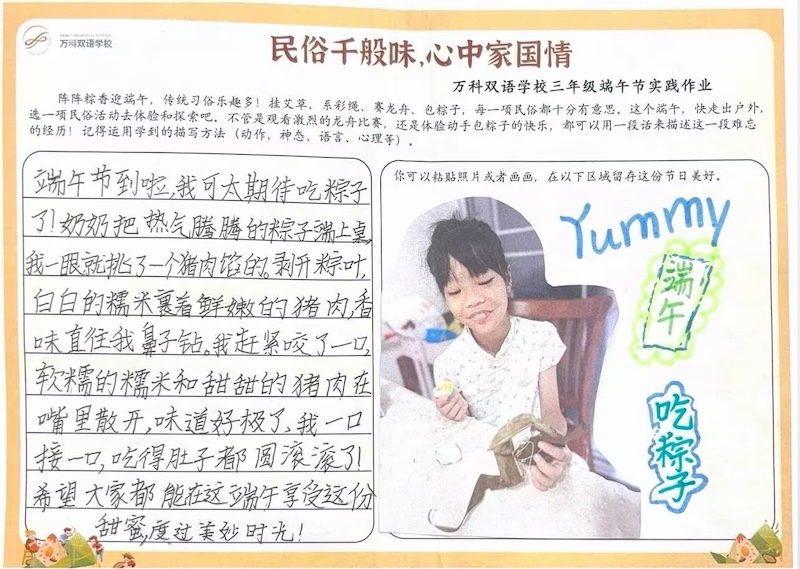
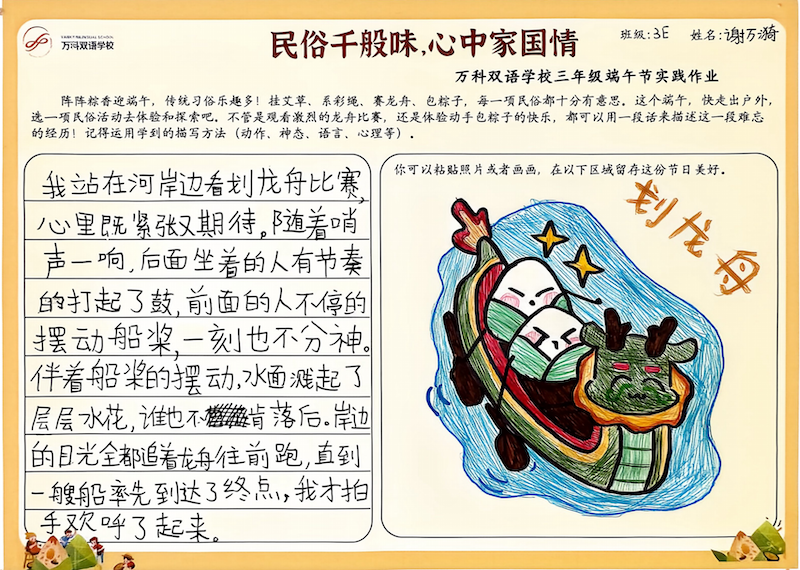
三年级正式步入“文化认知”的进阶。学生系统梳理端午的多元起源,并逐一解码悬挂艾草、佩戴香囊、饮雄黄酒、赛龙舟、食粽、系五色丝线、铸阳燧等七大习俗的历史流变与文化隐喻。从表层的“动手做”到深层的“懂得为何做”,学生的文化理解力由此生根。
Grade 3 formally enters the advanced stage of "cultural cognition." Students systematically sorted through the diverse origins of the Dragon Boat Festival and decoded, one by one, the historical evolution and cultural metaphors behind seven major customs: hanging mugwort, wearing sachets, drinking realgar wine, racing dragon boats, eating zongzi, tying five-colored silk threads, and crafting bronze mirrors. Moving from the surface level of "doing" to the deeper level of "understanding why," the students' cultural comprehension began to take root.
在跨学科链接中,让传统“活”在当下
Bringing Tradition to Life Through Interdisciplinary Connections
四年级:输入与输出的闭环,做文化的“转译者”
Grade 4: Closing the Loop between Input and Output—Becoming Cultural "Translators"
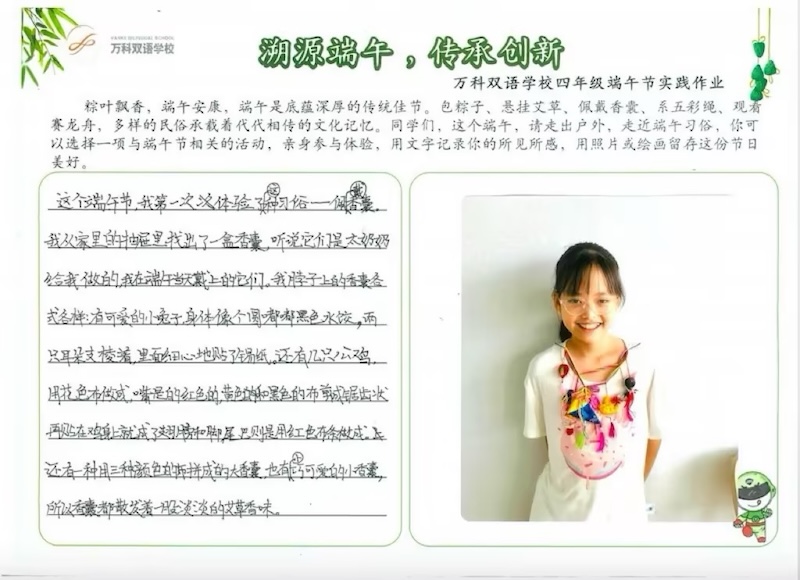
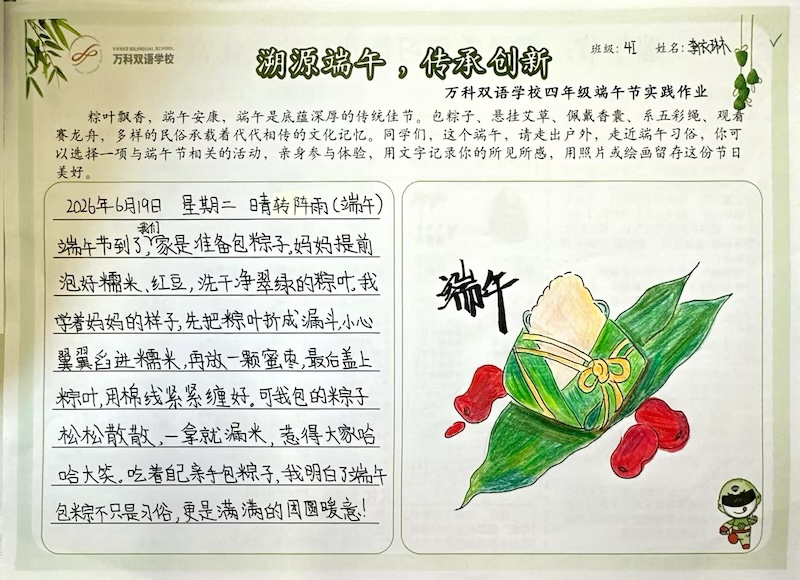
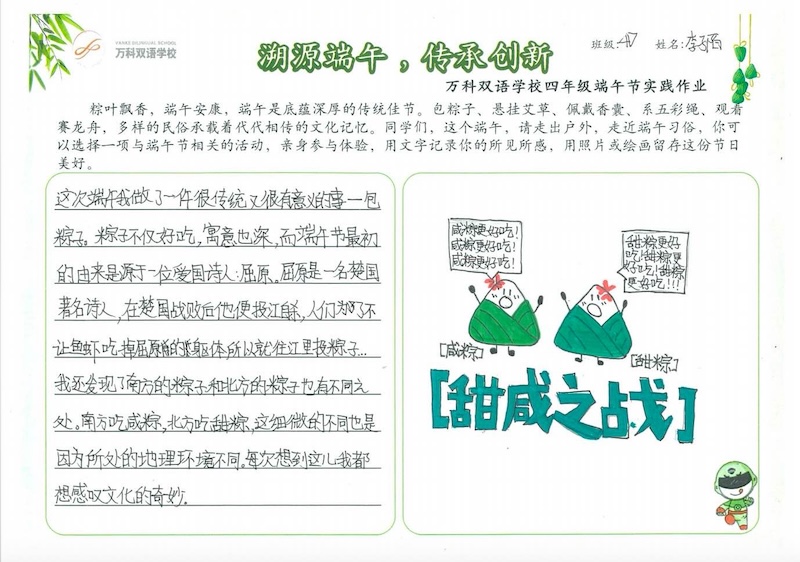
四年级在溯源学习的基础上,增设“表达与传播”任务。学生需向他人介绍一项端午知识,将文化理解转化为口语表达。这一过程迫使学生将碎片信息整合为逻辑清晰的表达,完成了从“知道”到“讲清”的关键跨越,让文化真正“流”过自己的身体。
Building on foundational learning, Grade 4 added an "expression and dissemination" task: students must introduce a Dragon Boat Festival custom to others, transforming cultural understanding into oral expression. This process compelled students to integrate obscure information into logically coherent narratives, completing the critical leap from "knowing" to "explaining," allowing culture to truly flow through themselves.
五年级:学科融合,龙舟与世界对话
Grade 5: Disciplinary Integration—Dragon Boats in a Dialogue with the World
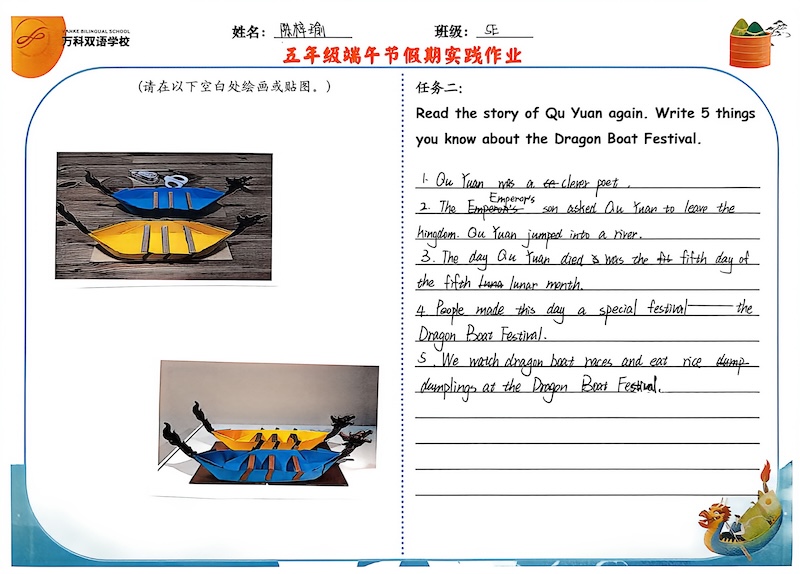
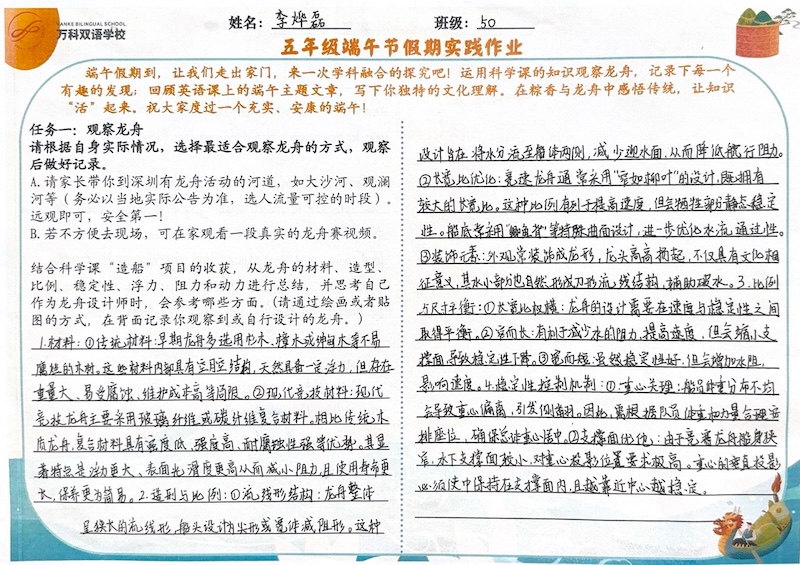
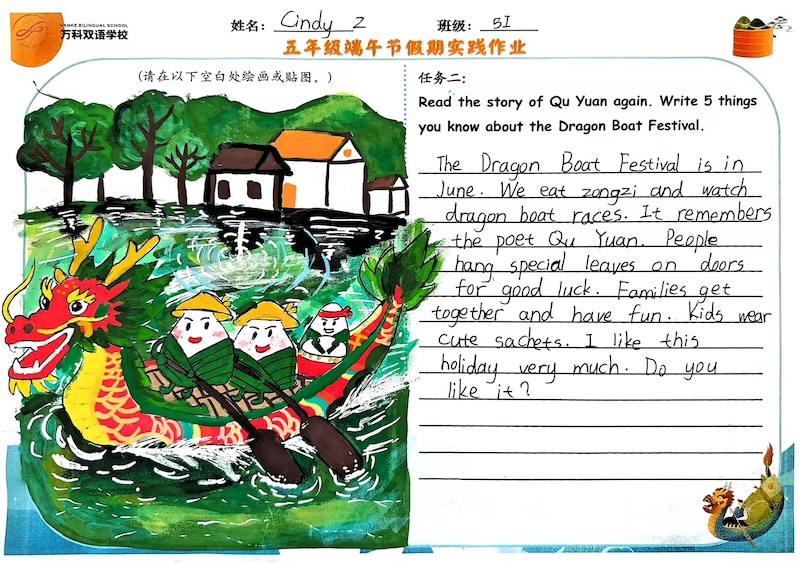
五年级借力科学课上“浮力与船体结构”的知识,观察龙舟造型,分析其流线型设计如何减少阻力;同时,以英语为媒介,梳理端午核心事实与文化符号,书写出节日内涵。当科学思维与语言表达交织在粽香之中,端午便成了一张通往世界的文化名片。
Leveraging knowledge of "buoyancy and hull structure" from science class, Grade 5 students observed dragon boat designs and analyzed how their streamlined shapes reduce drag. At the same time, using English, they organized key facts and cultural symbols of the festival and wrote about their deeper meanings. When scientific thinking and linguistic expression intertwine amid the fragrance of zongzi, the Dragon Boat Festival becomes a cultural passport to the world.
六年级:未来设计师,在传承中创造
Grade 6: Future Designers—Creating Through Inheritance
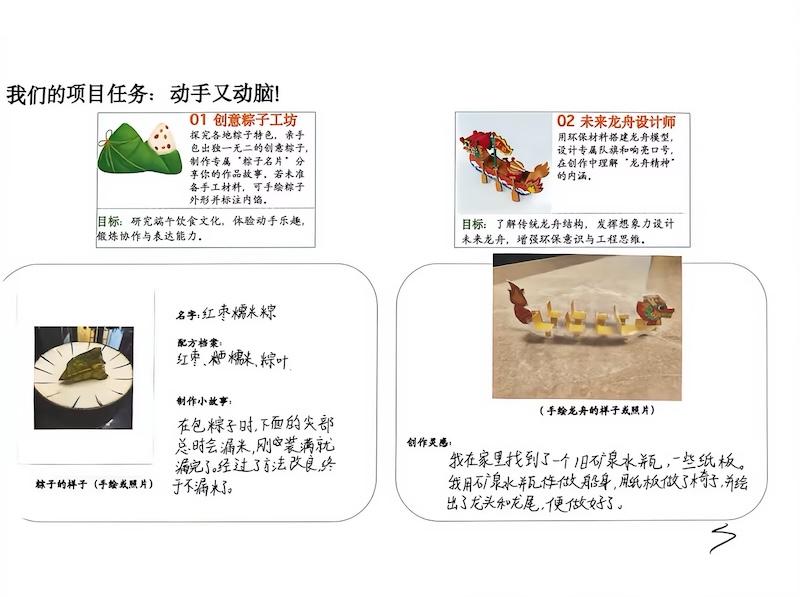
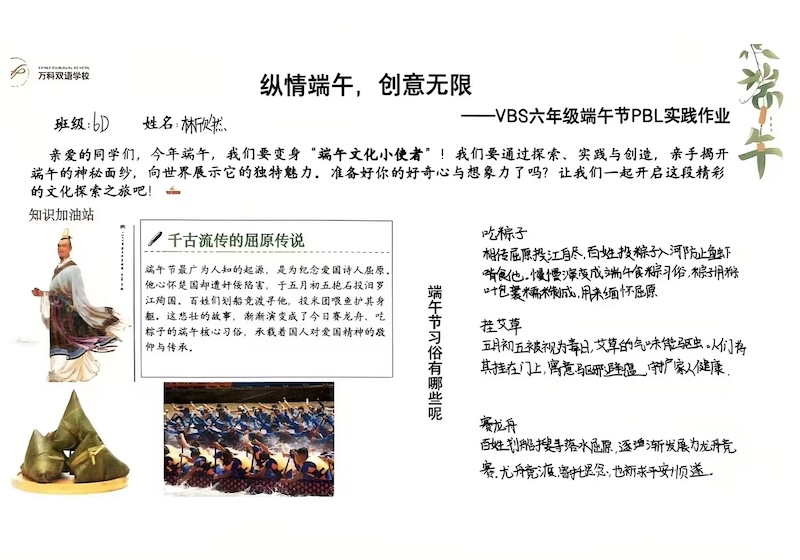
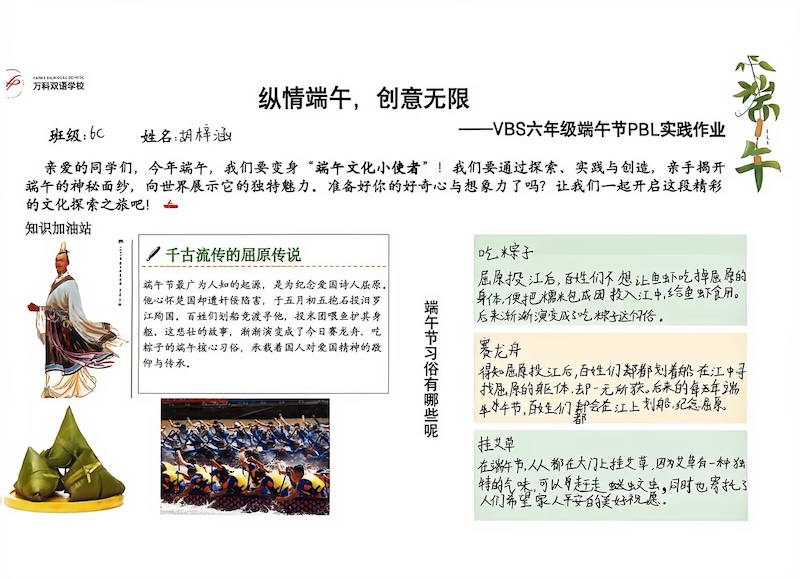
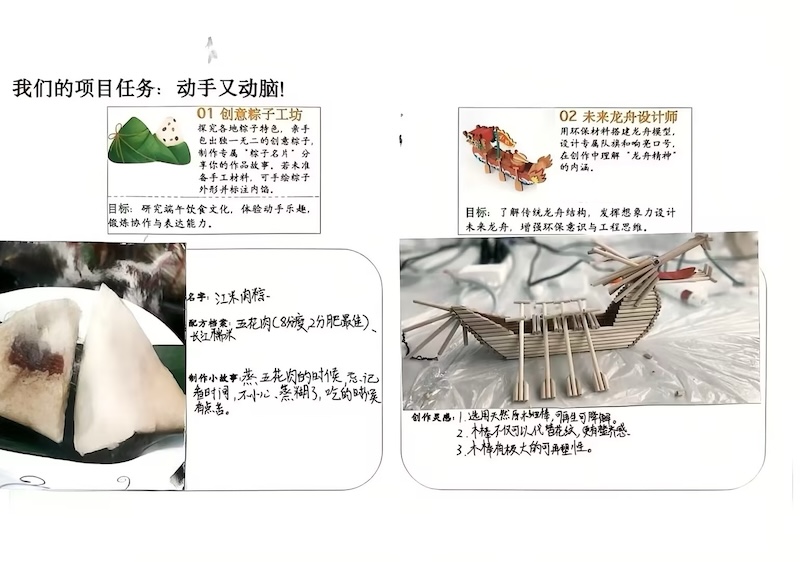
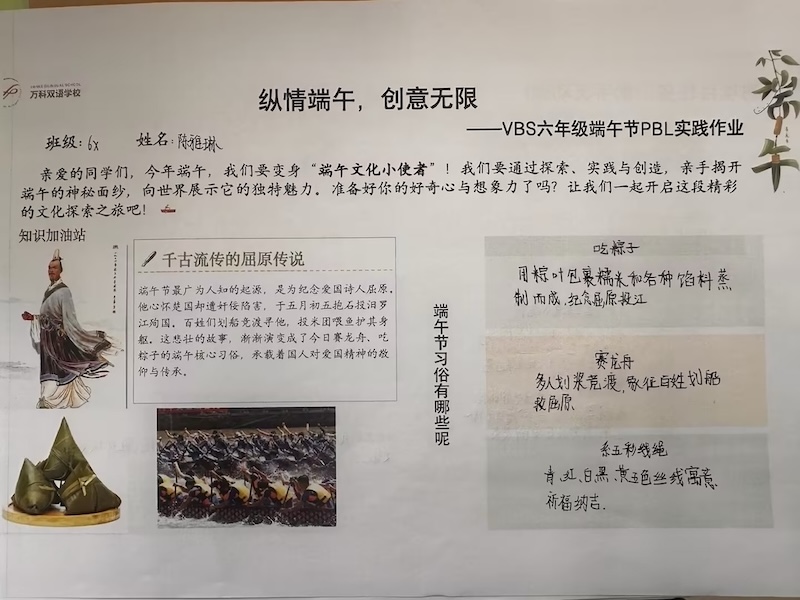
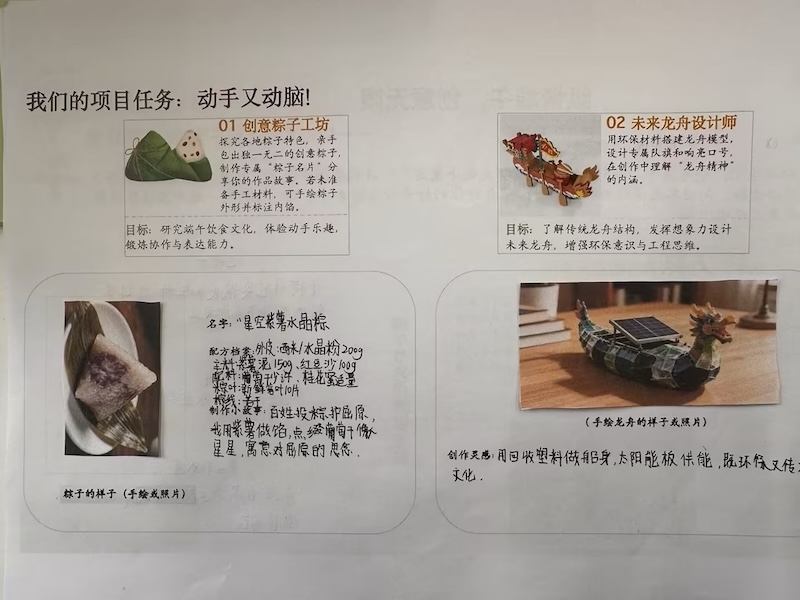
六年级学生化身“端午文化小使者”,设计创意粽子和未来龙舟,融合工程思维、环保意识与美学设计,深化文化理解。他们有的在包粽子时屡屡漏米,反复尝试终获成功;有的将废旧矿泉水瓶和纸板变身成威风龙舟......这正是文化传承在童心中最鲜活的注脚。当古老图腾在现代设计中焕发新生,学生的审美能力与成长型思维模式在实践中得到同步锻造。
Grade 6 students took on the role of "Dragon Boat Festival Cultural Envoys," designing creative zongzi and futuristic dragon boats that integrated engineering thinking, environmental awareness, and aesthetic design to deepen their cultural understanding. Some students, after repeated failed attempts at wrapping zongzi without leaking rice, eventually succeeded; others transformed discarded plastic water bottles and cardboard into majestic dragon boat models. These are the most vibrant footnotes of cultural inheritance taking root in children's hearts. As ancient relics come to life through modern design, students' aesthetic abilities and growth mindsets are simultaneously honed through practice.
在古今与中外的坐标轴上,做文化的“解码者”与“摆渡人”
On the Coordinate Axis of Past and Present, East and West—Becoming Cultural "Decoders" and "Ferrymen"
七年级:采访祖辈,凝视当下,思辨民俗之变
Grade 7: Interviewing Elders, Observing the Present, and Reflecting on Folk Custom Evolution
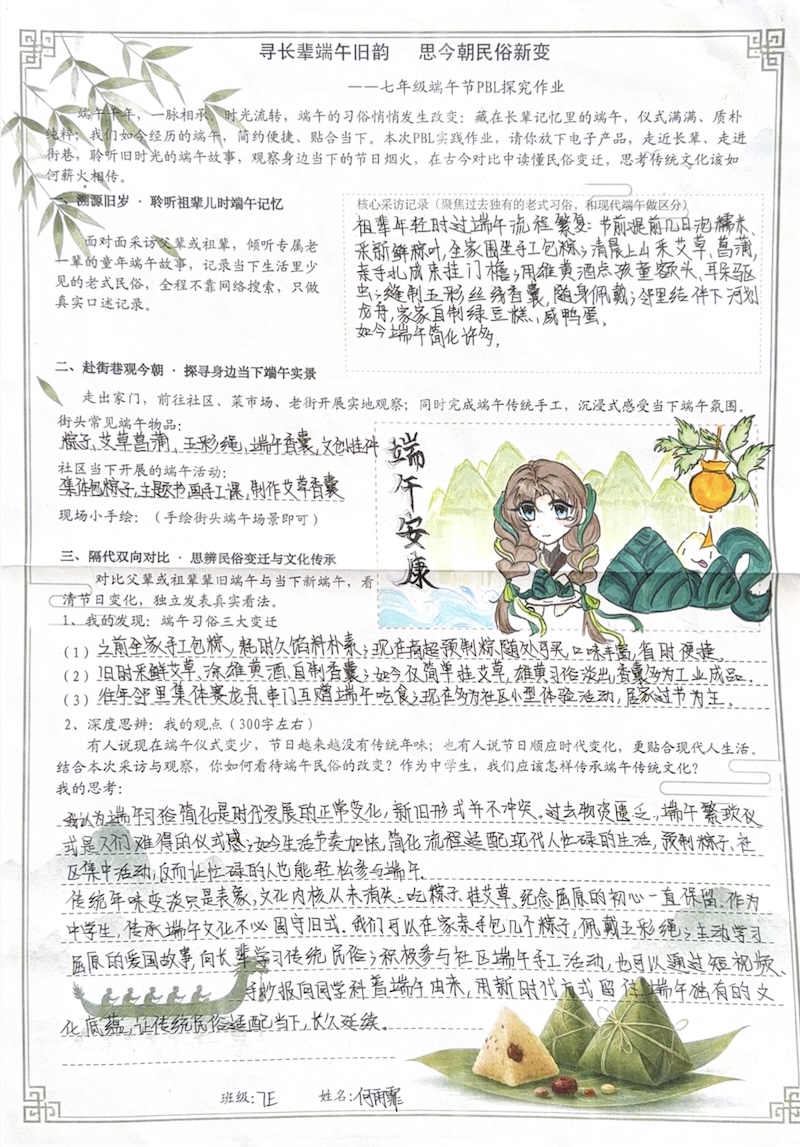
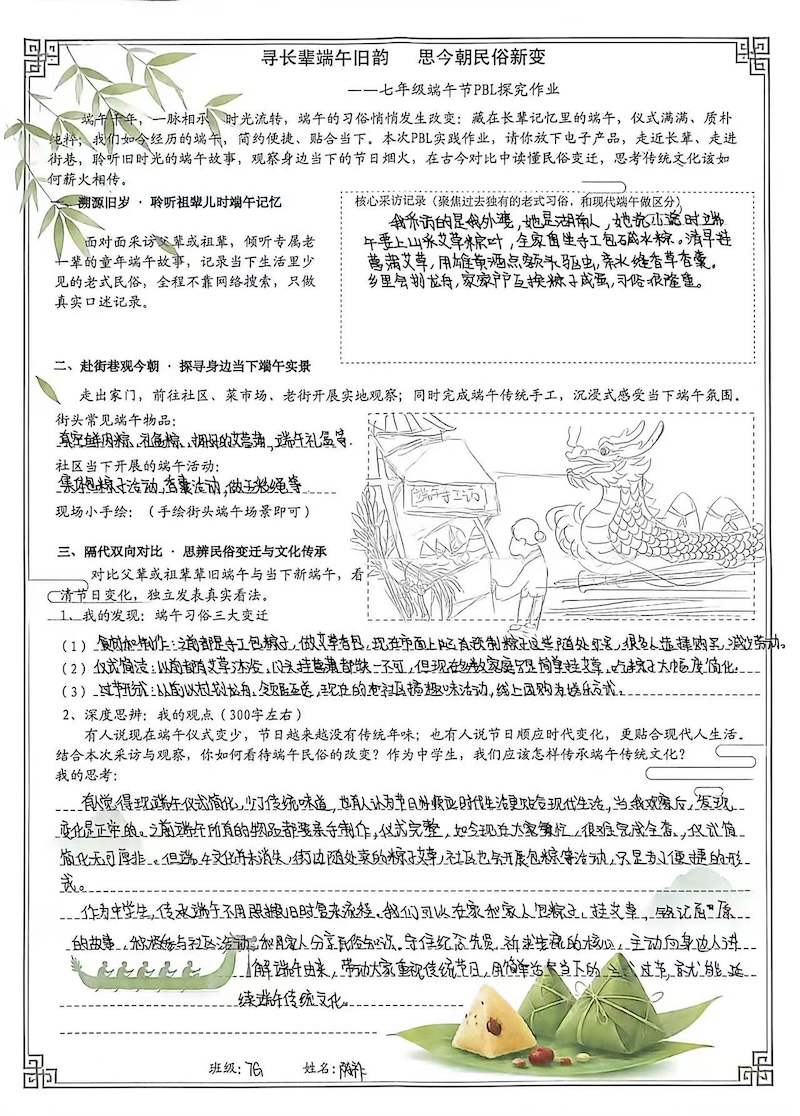
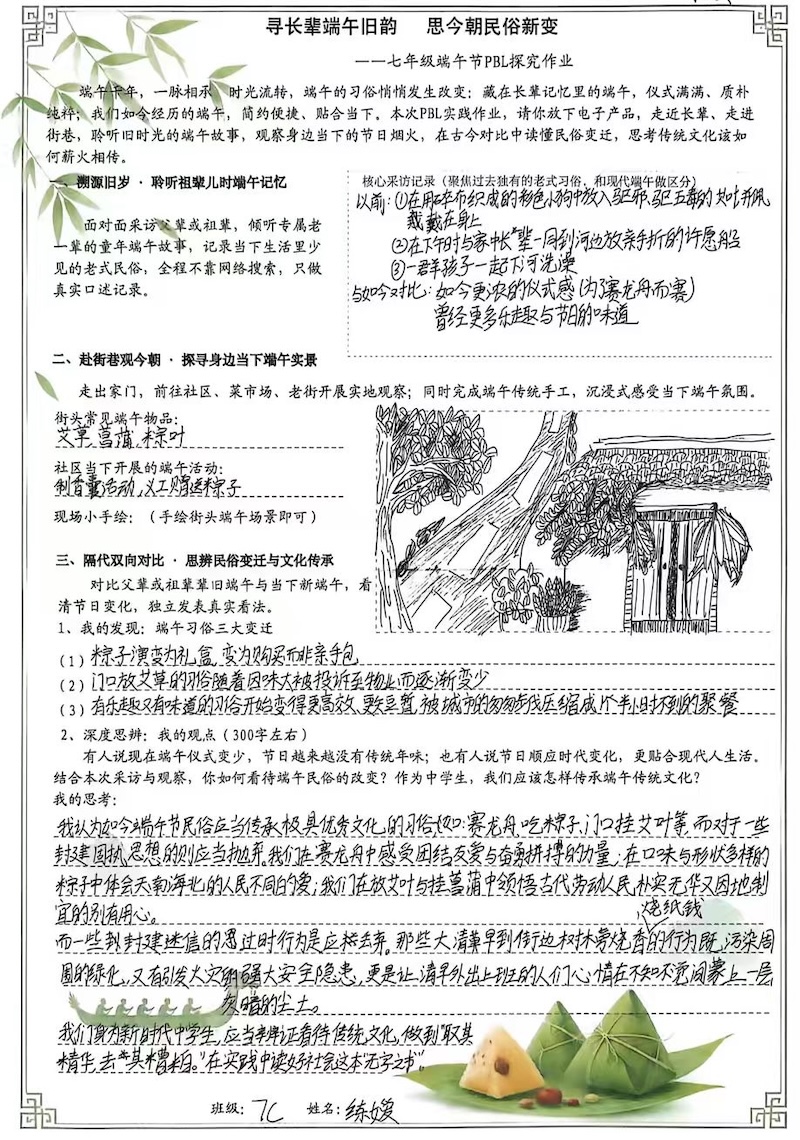
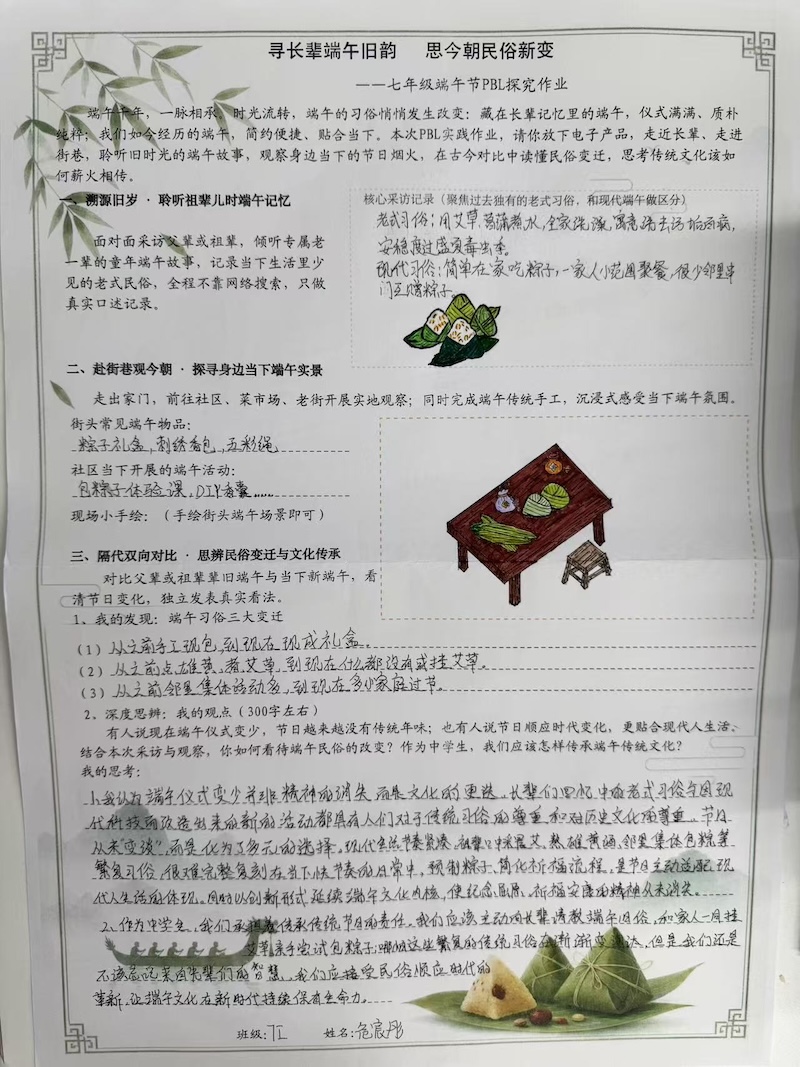
七年级学生通过采访祖辈复原几十年前的端午旧俗——用布编彩辫、下河洗澡、河边放风筝,质朴而富有烟火气;又走进街巷观察当下实景——赛龙舟更显仪式感,邻里围坐包粽的热闹却逐渐稀薄,手工粽也常被礼盒替代。孩子们并未止步于记录,更在对比中冷静思辨:赛龙舟、挂艾草等凝聚智慧与精神的习俗当接力传承,而烧香拜神等带有封建色彩的旧习应理性摒弃;老式习俗虽因现代节奏而简化,但粽子与艾草承载的祈福安康之内核从未消失。从"做什么"到"为何变",七年级学生在古今对照中读懂民俗变迁的逻辑,在思辨中习得"取其精华,去其糟粕"的文化态度,真正从被动的文化接受者,成长为主动的文化解码者。
Grade 7 students restored Dragon Boat Festival traditions from decades past by interviewing their grandparents—braiding colorful tassels from cloth, bathing in rivers, and flying kites by the water—that are full of the warmth of daily life. They also walked through neighborhoods to observe the present-day scene: dragon boat racing has become more ceremonial, while the lively neighborhood gatherings for zongzi-making have gradually faded, and handmade zongzi are often replaced by gift-boxed versions. The students did not stop at documentation; they engaged in calm critical reflection: customs like dragon boat racing and hanging mugwort, which embody wisdom and spirit, should be carried forward, while superstitious practices like burning incense and worshipping deities should be rationally abandoned. Though traditional customs have been simplified by the pace of modern life, the core essence of zongzi and mugwort—prayers for blessings and well-being—has never disappeared. From "what to do" to "why it changes," Grade 7 students grasped the logic behind folk custom evolution through past and present comparisons, and through critical thinking, they gained a cultural attitude of "absorbing the essence and discarding the excess," truly transforming from passive recipients of culture into active cultural decoders.
八年级:跨出国界,格物致知,探粽香之韵
Grade 8: Crossing Borders, Investigating Through Practice, and Exploring the Global Pulse of Zongzi
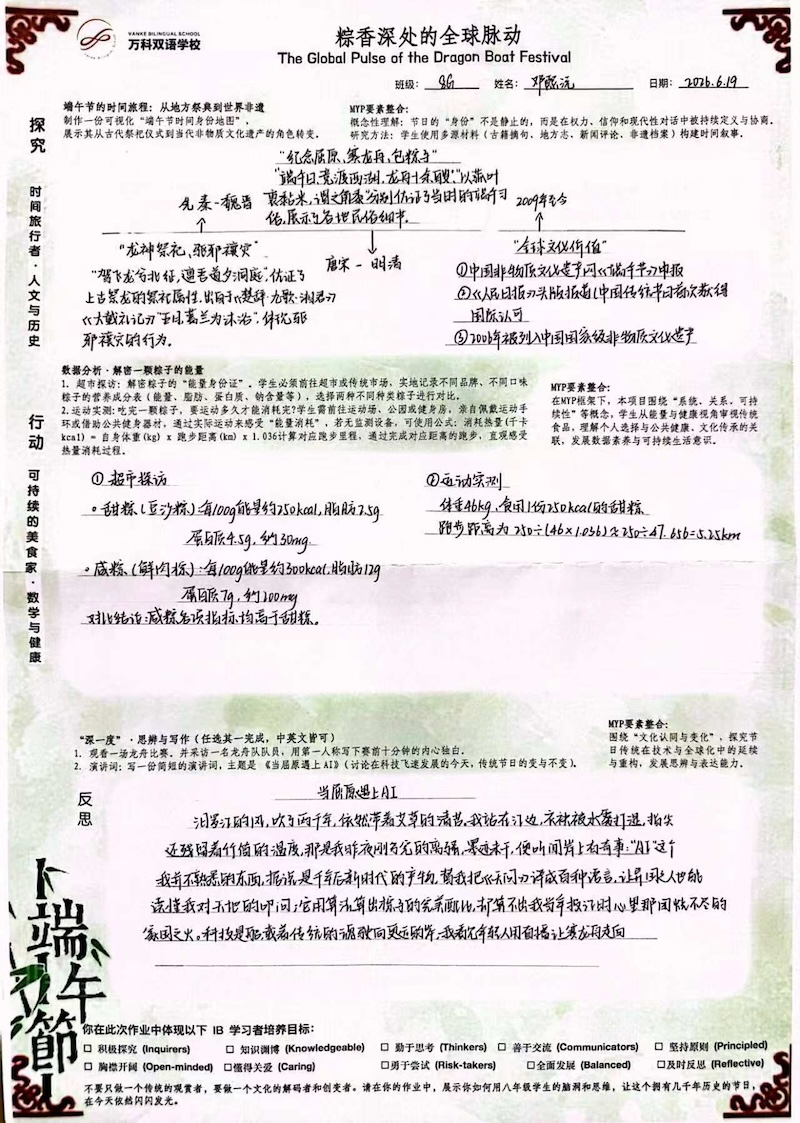
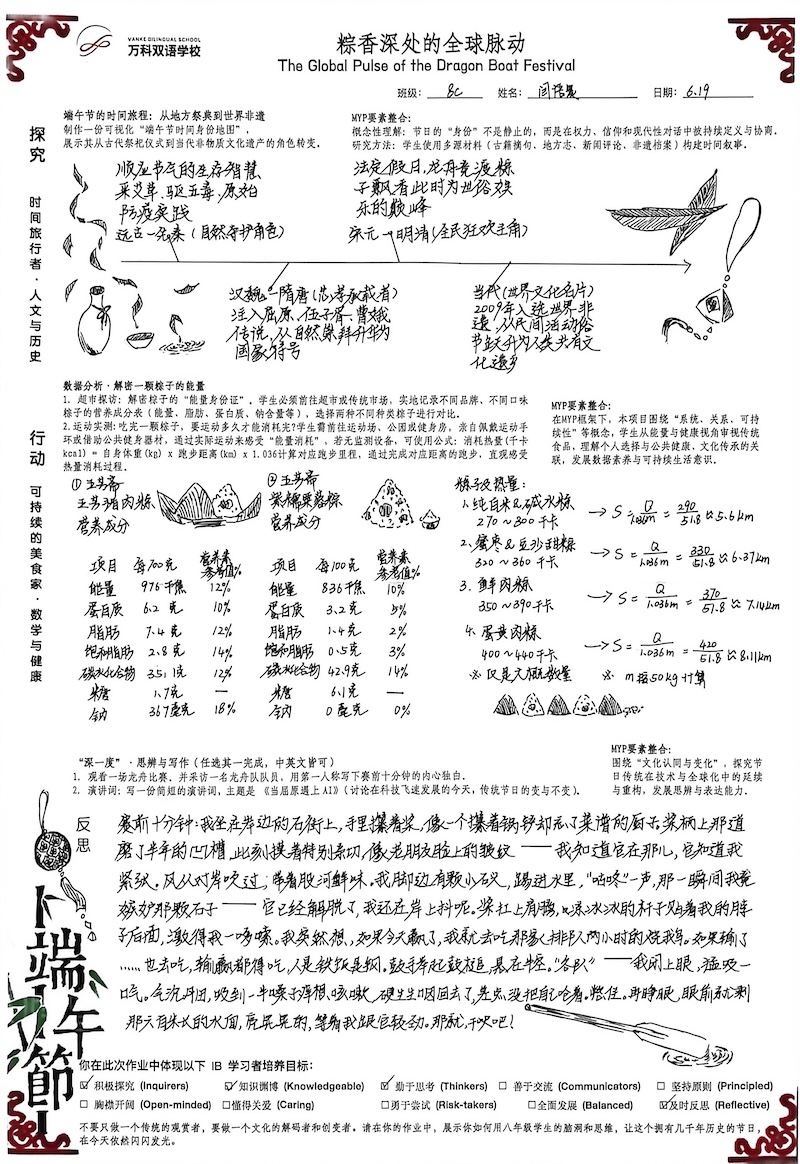
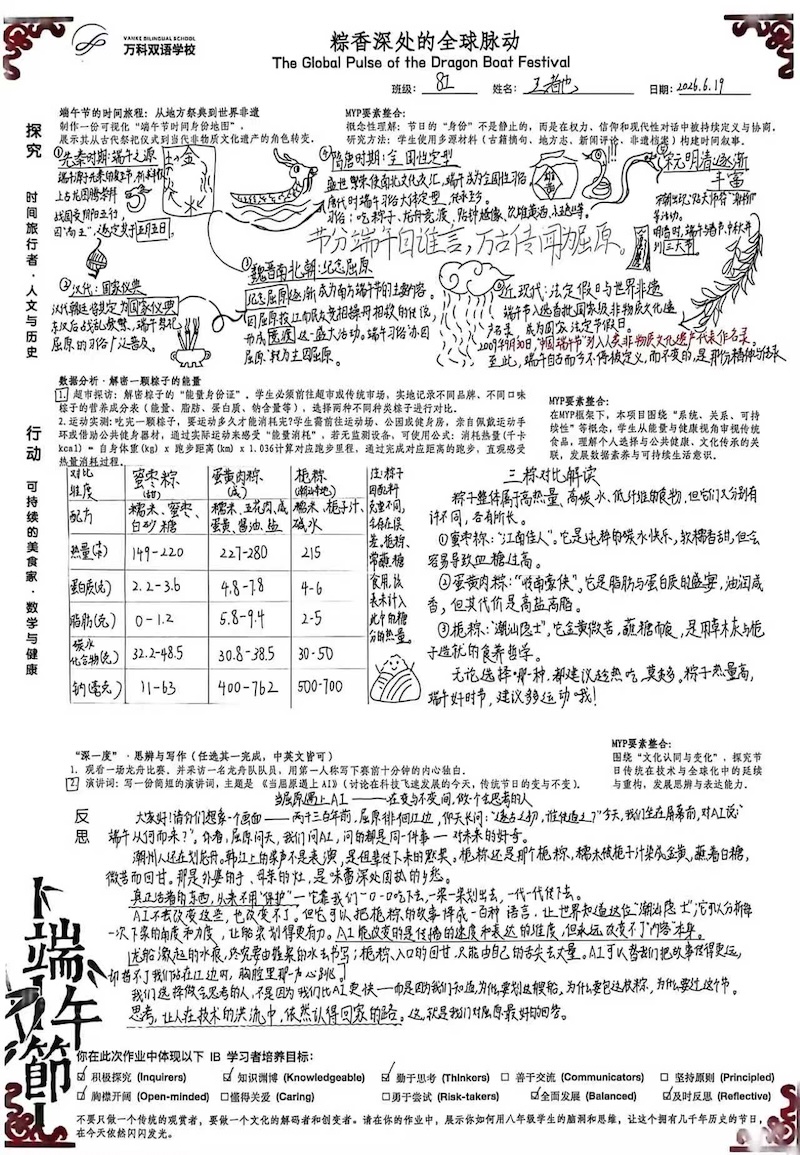
八年级开展了“粽香深处的全球脉动”跨学科实践作业。有的学生深入市场实地记录甜粽与咸粽的营养成分,并结合自身体重精准计算出“食用100克咸粽需跑步5.25公里”才能消耗殆尽,用数据让传统美食与现代健康观念展开对话;同时,学生们也大胆畅想《当屈原遇上AI》——让两千年前的诗人与人工智能相遇,在科技飞速发展的今天探讨传统节日的变与不变。从能量实验到未来畅想,八年级学生以科学实证对话传统文化,用开放视野链接全球脉动,让端午不再只是历史回望,更是面向未来的文化再创造。
Grade 8 launched the interdisciplinary "Global Pulse of the Dragon Boat Festival" project. Some students visited markets to record the nutritional content of sweet and savory zongzi, and based on their own body weight, precisely calculated that "eating 100 grams of savory zongzi requires running 5.25 kilometers" to burn off the calories—using data to spark a dialogue between traditional cuisine and modern health concepts. At the same time, students boldly envisioned "What If Qu Yuan Saw AI," bringing the ancient poet face-to-face with artificial intelligence to explore what changes and what endures in traditional festivals amid today's rapid technological advancement. From energy experiments to futuristic imagination, Grade 8 students engaged with traditional culture through scientific inquiry and connected with the global pulse with an open worldview, making the Dragon Boat Festival not merely a look back at history, but a creative reimagining for the future.
一叶粽叶,包裹千年文脉;一缕粽香,联通古今中外。万科双语学校以端午为媒,用分层递进的实践作业,让传统节日真正走进学生生活。从亲历民俗的感官体验,到跨学科融合的深度探究,再到古今思辨、中外对话的格局视野,孩子们在动手实践中触摸文化根脉,在思考创造中激活传统生命力。
One zongzi leaf wraps a thousand-year cultural legacy; one wisp of zongzi fragrance bridges ancient and modern, East and West. Vanke Bilingual School uses the Dragon Boat Festival as a medium and a tiered practical assignment system to bring traditional festivals into students' lives. From sensory experience of folk customs, to interdisciplinary deep inquiry, and then to historical reflection and cross-cultural dialogue, students touched the roots of culture through hands-on practice and experience traditional vitality through thinking and creation.
粽香悠悠,传承不息;文脉绵长,未来可期。愿每一位学子都能在传统与现代、东方与世界的交汇中,守住文化之根,拓宽国际视野,成长为有根脉、有思辨、有担当的新时代少年,让中华优秀传统文化在青春力量中生生不息、薪火相传。
The fragrance of zongzi lingers, and inheritance never ceases; the cultural lineage stretches far, and the future is full of promise. May every student, at the intersection of tradition and modernity, of East and West, hold fast to their cultural roots while broadening their global vision, turning into rooted, reflective, and responsible young people of the new era—so that the splendid traditional culture of China may thrive and be passed down from generation to generation through the power of youth.
资料提供/ 彭平、于彬
翻译/ 于彬
Proofreading of translation/ Timothy Beers
排版/ 马葳
万双网讯 端午,不只是一枚粽子的清香、一束艾草的芬芳,更是一场跨越两千余年的文化对话。今年端午,万科双语学校为一至八年级学生精心设计了分层递进、各具特色的实践作业体系——从“亲历感知”到“解码理解”,再到“思辨创新”,力求让每一位学生都能在适切的认知梯度上,触摸传统、审视当下、构想未来,真正实现“探究”“行动”“反思”三位一体的深度学习。
The Dragon Boat Festival is more than the fragrance of zongzi or the freshness of mugwort—it is a cultural dialogue spanning over two thousand years. This year, Vanke Bilingual School designed a practical assignment system for students from Grade 1 to Grade 8—guiding them with firsthand experience to decode and understand to enhance critical thinking and innovation. The goal was to enable every student, to touch tradition, examine the present, and envision the future; achieving deep learning associated with inquiry, action, and reflection.
在指尖与粽叶间,种下文化的“第一粒种子”
Planting the First Seeds of Culture Between Fingertips and Zongzi Leaves
一年级:亲子共融,感官启航
Grade 1: Family Engagement, Sensory Awakening
一年级的实践以“家庭”为场域、以“陪伴”为纽带。孩子们通过包粽子赠长辈、观龙舟竞渡、系五彩丝线,在河畔呐喊助威间感受力与美的激荡,腕间缠绕的缕缕彩线,则化作节日最灵动的视觉印记。最终,孩子们用相机定格笑脸、用画笔涂鸦记忆,让端午不再只是日历上的标注,而是可感、可触、可爱的童年片段。
The Grade 1 practice takes family and companionship as its setting and bond. Children make zongzi for their elders, watch dragon boat races, and tie colorful silk threads. Amidst the cheers along the riverside, they feel the interplay of power and beauty; the colorful threads wrapped around their wrists become the most vivid visual imprint of the festival. In the end, they freeze smiles with cameras and record memories with paintbrushes, transforming the Dragon Boat Festival from a date on the calendar into a tangible, touchable, and endearing fragment of childhood.
二年级:行走民俗,穿越对话
Grade 2: Experiencing Folk Customs on Foot and Time-Travel Dialogue
二年级学生走出家门,深度参与到真实民俗中去——包粽子的米香、编彩绳的指尖巧思,皆成为真实的感官教材。而“穿越挑战”任务则别具匠心:假如你穿越回战国,会向屈原提出怎样的治国建议?孩子们在童言稚语中融合历史感知与现代公民意识,让古老人物与当下思维碰撞出奇妙的火花。
Grade 2 students stepped out of their homes and immersed themselves in authentic folk customs—the aroma of sticky rice in zongzi-making and the dexterity of braiding colorful ropes became sensory lessons. The "Time-Travel Challenge" task was particularly ingenious: if you traveled back to the Warring States period, what advice would you offer Qu Yuan? Through innocent yet insightful words, children blended historical perceptions with modern civic awareness, sparking a wonderful collision between ancient figures and contemporary thinking.
三年级:溯源解码,从“做什么”到“为什么”
Grade 3: Tracing Origins and Decoding—from "What" to "Why"
三年级正式步入“文化认知”的进阶。学生系统梳理端午的多元起源,并逐一解码悬挂艾草、佩戴香囊、饮雄黄酒、赛龙舟、食粽、系五色丝线、铸阳燧等七大习俗的历史流变与文化隐喻。从表层的“动手做”到深层的“懂得为何做”,学生的文化理解力由此生根。
Grade 3 formally enters the advanced stage of "cultural cognition." Students systematically sorted through the diverse origins of the Dragon Boat Festival and decoded, one by one, the historical evolution and cultural metaphors behind seven major customs: hanging mugwort, wearing sachets, drinking realgar wine, racing dragon boats, eating zongzi, tying five-colored silk threads, and crafting bronze mirrors. Moving from the surface level of "doing" to the deeper level of "understanding why," the students' cultural comprehension began to take root.
在跨学科链接中,让传统“活”在当下
Bringing Tradition to Life Through Interdisciplinary Connections
四年级:输入与输出的闭环,做文化的“转译者”
Grade 4: Closing the Loop between Input and Output—Becoming Cultural "Translators"
四年级在溯源学习的基础上,增设“表达与传播”任务。学生需向他人介绍一项端午知识,将文化理解转化为口语表达。这一过程迫使学生将碎片信息整合为逻辑清晰的表达,完成了从“知道”到“讲清”的关键跨越,让文化真正“流”过自己的身体。
Building on foundational learning, Grade 4 added an "expression and dissemination" task: students must introduce a Dragon Boat Festival custom to others, transforming cultural understanding into oral expression. This process compelled students to integrate obscure information into logically coherent narratives, completing the critical leap from "knowing" to "explaining," allowing culture to truly flow through themselves.
五年级:学科融合,龙舟与世界对话
Grade 5: Disciplinary Integration—Dragon Boats in a Dialogue with the World
五年级借力科学课上“浮力与船体结构”的知识,观察龙舟造型,分析其流线型设计如何减少阻力;同时,以英语为媒介,梳理端午核心事实与文化符号,书写出节日内涵。当科学思维与语言表达交织在粽香之中,端午便成了一张通往世界的文化名片。
Leveraging knowledge of "buoyancy and hull structure" from science class, Grade 5 students observed dragon boat designs and analyzed how their streamlined shapes reduce drag. At the same time, using English, they organized key facts and cultural symbols of the festival and wrote about their deeper meanings. When scientific thinking and linguistic expression intertwine amid the fragrance of zongzi, the Dragon Boat Festival becomes a cultural passport to the world.
六年级:未来设计师,在传承中创造
Grade 6: Future Designers—Creating Through Inheritance
六年级学生化身“端午文化小使者”,设计创意粽子和未来龙舟,融合工程思维、环保意识与美学设计,深化文化理解。他们有的在包粽子时屡屡漏米,反复尝试终获成功;有的将废旧矿泉水瓶和纸板变身成威风龙舟......这正是文化传承在童心中最鲜活的注脚。当古老图腾在现代设计中焕发新生,学生的审美能力与成长型思维模式在实践中得到同步锻造。
Grade 6 students took on the role of "Dragon Boat Festival Cultural Envoys," designing creative zongzi and futuristic dragon boats that integrated engineering thinking, environmental awareness, and aesthetic design to deepen their cultural understanding. Some students, after repeated failed attempts at wrapping zongzi without leaking rice, eventually succeeded; others transformed discarded plastic water bottles and cardboard into majestic dragon boat models. These are the most vibrant footnotes of cultural inheritance taking root in children's hearts. As ancient relics come to life through modern design, students' aesthetic abilities and growth mindsets are simultaneously honed through practice.
在古今与中外的坐标轴上,做文化的“解码者”与“摆渡人”
On the Coordinate Axis of Past and Present, East and West—Becoming Cultural "Decoders" and "Ferrymen"
七年级:采访祖辈,凝视当下,思辨民俗之变
Grade 7: Interviewing Elders, Observing the Present, and Reflecting on Folk Custom Evolution
七年级学生通过采访祖辈复原几十年前的端午旧俗——用布编彩辫、下河洗澡、河边放风筝,质朴而富有烟火气;又走进街巷观察当下实景——赛龙舟更显仪式感,邻里围坐包粽的热闹却逐渐稀薄,手工粽也常被礼盒替代。孩子们并未止步于记录,更在对比中冷静思辨:赛龙舟、挂艾草等凝聚智慧与精神的习俗当接力传承,而烧香拜神等带有封建色彩的旧习应理性摒弃;老式习俗虽因现代节奏而简化,但粽子与艾草承载的祈福安康之内核从未消失。从"做什么"到"为何变",七年级学生在古今对照中读懂民俗变迁的逻辑,在思辨中习得"取其精华,去其糟粕"的文化态度,真正从被动的文化接受者,成长为主动的文化解码者。
Grade 7 students restored Dragon Boat Festival traditions from decades past by interviewing their grandparents—braiding colorful tassels from cloth, bathing in rivers, and flying kites by the water—that are full of the warmth of daily life. They also walked through neighborhoods to observe the present-day scene: dragon boat racing has become more ceremonial, while the lively neighborhood gatherings for zongzi-making have gradually faded, and handmade zongzi are often replaced by gift-boxed versions. The students did not stop at documentation; they engaged in calm critical reflection: customs like dragon boat racing and hanging mugwort, which embody wisdom and spirit, should be carried forward, while superstitious practices like burning incense and worshipping deities should be rationally abandoned. Though traditional customs have been simplified by the pace of modern life, the core essence of zongzi and mugwort—prayers for blessings and well-being—has never disappeared. From "what to do" to "why it changes," Grade 7 students grasped the logic behind folk custom evolution through past and present comparisons, and through critical thinking, they gained a cultural attitude of "absorbing the essence and discarding the excess," truly transforming from passive recipients of culture into active cultural decoders.
八年级:跨出国界,格物致知,探粽香之韵
Grade 8: Crossing Borders, Investigating Through Practice, and Exploring the Global Pulse of Zongzi
八年级开展了“粽香深处的全球脉动”跨学科实践作业。有的学生深入市场实地记录甜粽与咸粽的营养成分,并结合自身体重精准计算出“食用100克咸粽需跑步5.25公里”才能消耗殆尽,用数据让传统美食与现代健康观念展开对话;同时,学生们也大胆畅想《当屈原遇上AI》——让两千年前的诗人与人工智能相遇,在科技飞速发展的今天探讨传统节日的变与不变。从能量实验到未来畅想,八年级学生以科学实证对话传统文化,用开放视野链接全球脉动,让端午不再只是历史回望,更是面向未来的文化再创造。
Grade 8 launched the interdisciplinary "Global Pulse of the Dragon Boat Festival" project. Some students visited markets to record the nutritional content of sweet and savory zongzi, and based on their own body weight, precisely calculated that "eating 100 grams of savory zongzi requires running 5.25 kilometers" to burn off the calories—using data to spark a dialogue between traditional cuisine and modern health concepts. At the same time, students boldly envisioned "What If Qu Yuan Saw AI," bringing the ancient poet face-to-face with artificial intelligence to explore what changes and what endures in traditional festivals amid today's rapid technological advancement. From energy experiments to futuristic imagination, Grade 8 students engaged with traditional culture through scientific inquiry and connected with the global pulse with an open worldview, making the Dragon Boat Festival not merely a look back at history, but a creative reimagining for the future.
一叶粽叶,包裹千年文脉;一缕粽香,联通古今中外。万科双语学校以端午为媒,用分层递进的实践作业,让传统节日真正走进学生生活。从亲历民俗的感官体验,到跨学科融合的深度探究,再到古今思辨、中外对话的格局视野,孩子们在动手实践中触摸文化根脉,在思考创造中激活传统生命力。
One zongzi leaf wraps a thousand-year cultural legacy; one wisp of zongzi fragrance bridges ancient and modern, East and West. Vanke Bilingual School uses the Dragon Boat Festival as a medium and a tiered practical assignment system to bring traditional festivals into students' lives. From sensory experience of folk customs, to interdisciplinary deep inquiry, and then to historical reflection and cross-cultural dialogue, students touched the roots of culture through hands-on practice and experience traditional vitality through thinking and creation.
粽香悠悠,传承不息;文脉绵长,未来可期。愿每一位学子都能在传统与现代、东方与世界的交汇中,守住文化之根,拓宽国际视野,成长为有根脉、有思辨、有担当的新时代少年,让中华优秀传统文化在青春力量中生生不息、薪火相传。
The fragrance of zongzi lingers, and inheritance never ceases; the cultural lineage stretches far, and the future is full of promise. May every student, at the intersection of tradition and modernity, of East and West, hold fast to their cultural roots while broadening their global vision, turning into rooted, reflective, and responsible young people of the new era—so that the splendid traditional culture of China may thrive and be passed down from generation to generation through the power of youth.
资料提供/ 彭平、于彬
翻译/ 于彬
Proofreading of translation/ Timothy Beers
排版/ 马葳

让孩子站在未来中央
地址:深圳市龙华区民治街道华南路80号
Tel:0755-66866333
Email:p-vbs@msedu.email

办学理念:让孩子站在未来中央
培养(成长)目标:培养(成为)身体健康、人格健全、学力卓越,具有家国情怀和国际视野, 敢于创造美好未来的中国公民,为开创更美好、更和平的世界贡献力量。 地址:深圳市龙华区民治街道华南路80号 电话:0755-66866333 http://vbs.vanke.com Vanke Bilingual School, Longhua District, Shenzhen Educational Idea: Let our children experience the future. Training objectives: Our students will become citizens of China with good physical health, sound personality, excellent academic abilities, patriotism, international vision and the courage to create a better future and a more peaceful world. Address: No.80 Huanan Road, Minzhi Sub-district, Longhua District, Shenzhen Contact: 0755-66866333 http://vbs.vanke.com
学校网站二维码
QR code of school website
学校公众号二维码
QR code of school official account
